HOLLIS is Harvard’s library catalog.
To narrow a search to the holdings of the CHS, use the following 2 options:
- Enter terms in the search bar, then select “Library Catalog” and in the second drop down menu limit to the “Center for Hellenic Studies.” Then click on the search icon (a magnifying glass). On the results page, use the menus along the right-hand margin to narrow your search.
- The Advanced Search appears in the top banner next to the HOLLIS logo. To limit to CHS, select “Library Catalog” from the radio buttons and the search scope for locations will appear. Select “Center for Hellenic Studies” and add your search term. Here you can also filter by resource type (e.g., journal), language, and publication date.
Once you have located a call number, note the location in the CHS library (e.g., GENERAL, REFERENCE, FOLIO, OVERSIZE, PERIODICALS, EPIPAP, RARE, OFF-SITE STORAGE) as this designation also determines a book’s location in the library.


Transliteration
Many Greek book titles in HOLLIS are transliterated using Roman characters. Please consult the following chart to understand how to type and read Greek titles in HOLLIS: https://www.loc.gov/catdir/cpso/romanization/greek.pdf. Also, the National Library of Greece has created this nifty conversion tool: transliteration.nlg.gr .
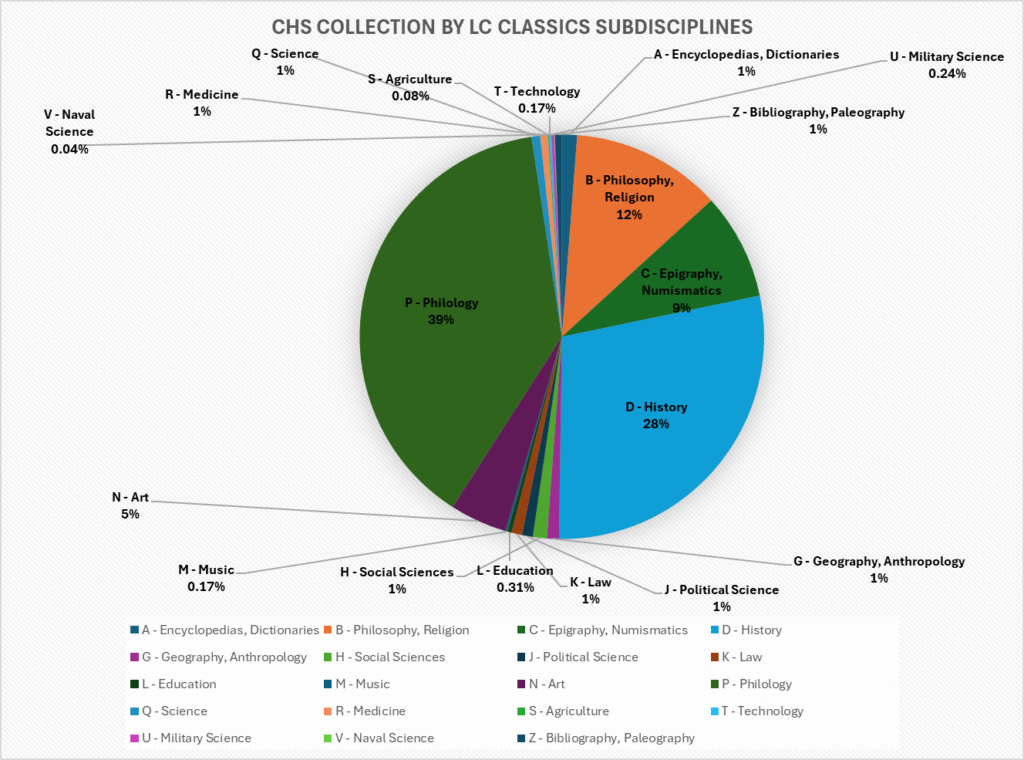
Collection by LC Classics Subdisciplines
For historical reasons the CHS collections are particularly strong in ancient Greek language and literature, history, and philosophy. The collections bordering on history such as epigraphy and numismatics are also strong.
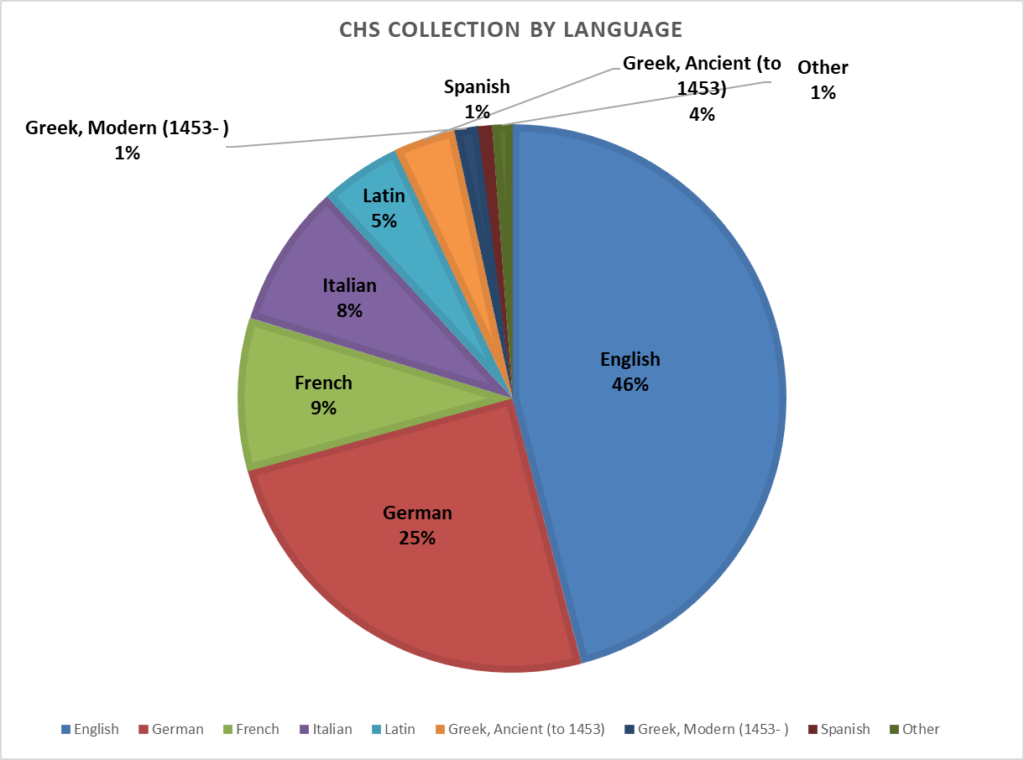
Collection Languages
The CHS collections comprise materials in 35 languages with a majority of items in the languages represented below.
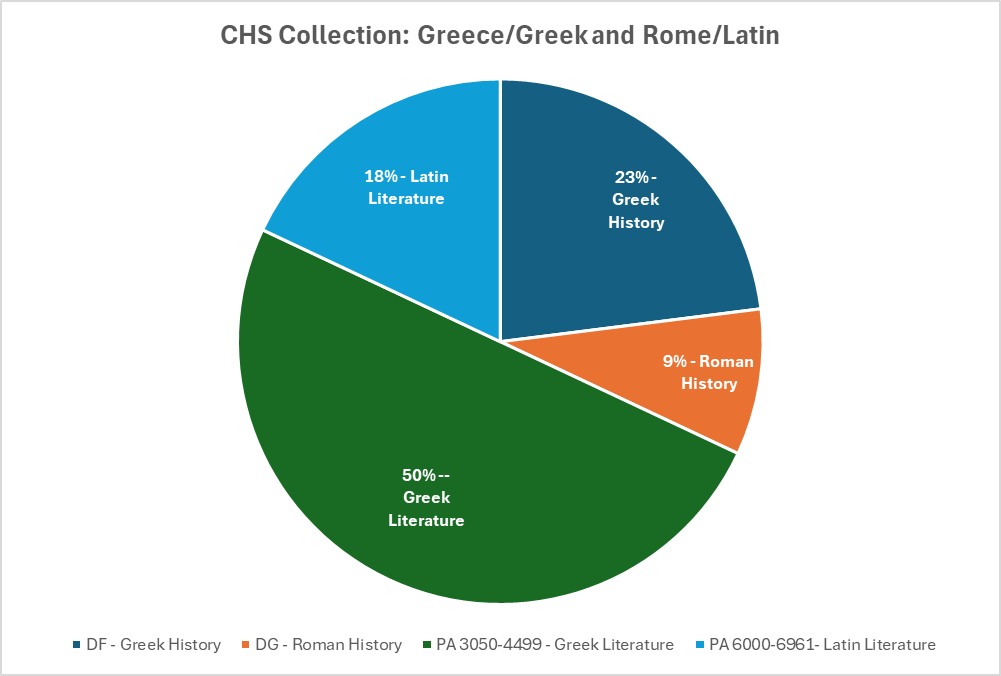
History and Literature Collections
As the focus of the CHS Library is ancient Greece, it collects selectively in the area of Rome except for items for comparanda and Greco-Roman Hellenistic materials, and works on Magna Graecia.
Browsing
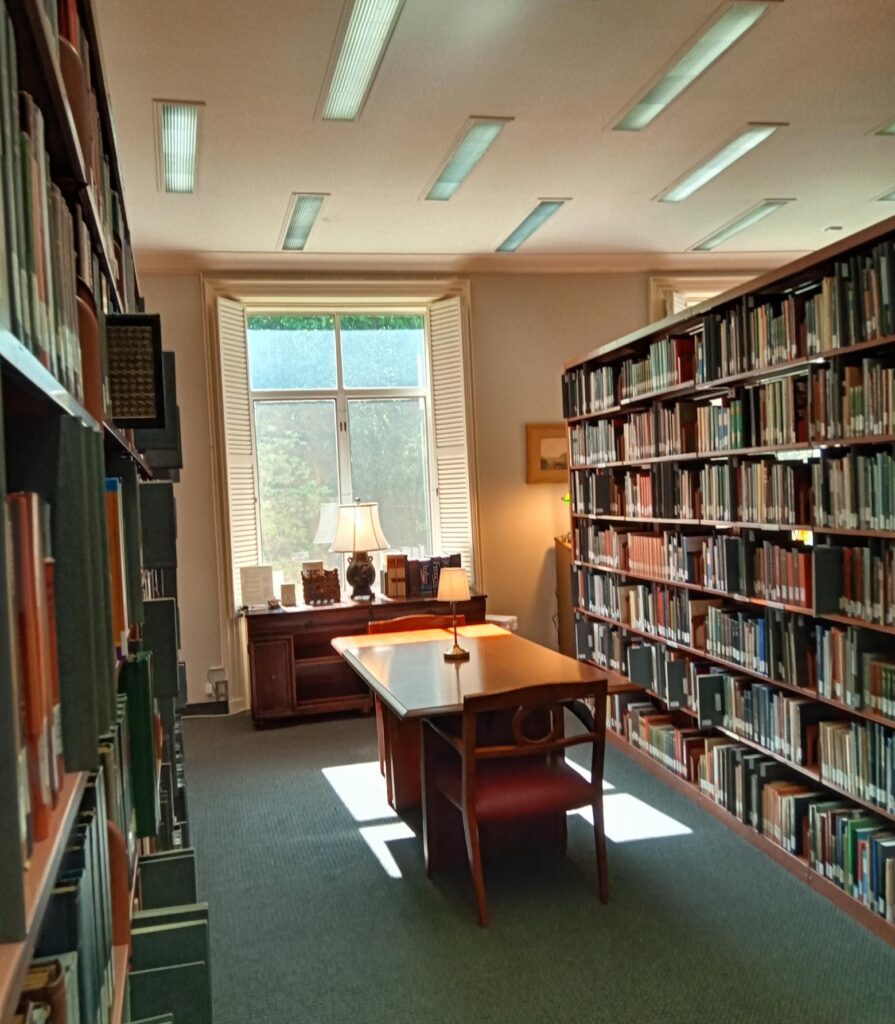
Again and again, we hear from young fellows how important the ability to browse is to them because of the possibility of serendipitous discoveries. As many as the advantages are with e-resources (ability to access items from anywhere, to conduct keyword searching, etc.), it is not as easy to discover unfamiliar books on a similar topic. If you wish to browse the collection by, for example, an author, that is certainly possible as the CHS library has an open stacks print collection and ancient authors are classified in alphabetical order in the PA call number section on the upstairs floor, followed by translations and commentaries and critical works. Do keep in mind, though, that there are authors such as Aristotle who may not only be found in the PA section as a literary author but also as a writer of philosophy, zoology, physics, etc., i.e., to be comprehensive when browsing, you may need to check also other call number sections such as B, esp., B108-708, for (ancient) philosophy, QL for zoology, QC for physics, etc., on the downstairs floor of the library. However, the way to locate a specific individual title in a collection of ca. 75,000 volumes is to look up its call number in the library catalog.
Locating Materials by Call Number and Location
Upstairs, main floor: All regular size books with call numbers in the PA (classical languages and literatures) range.
There are a few language dictionaries on the cupboard upstairs as well as the Barrington Atlas of the Greek and Roman World (Talbert) on the slanted map stand in the aisle by the windows for reference, not for check out.
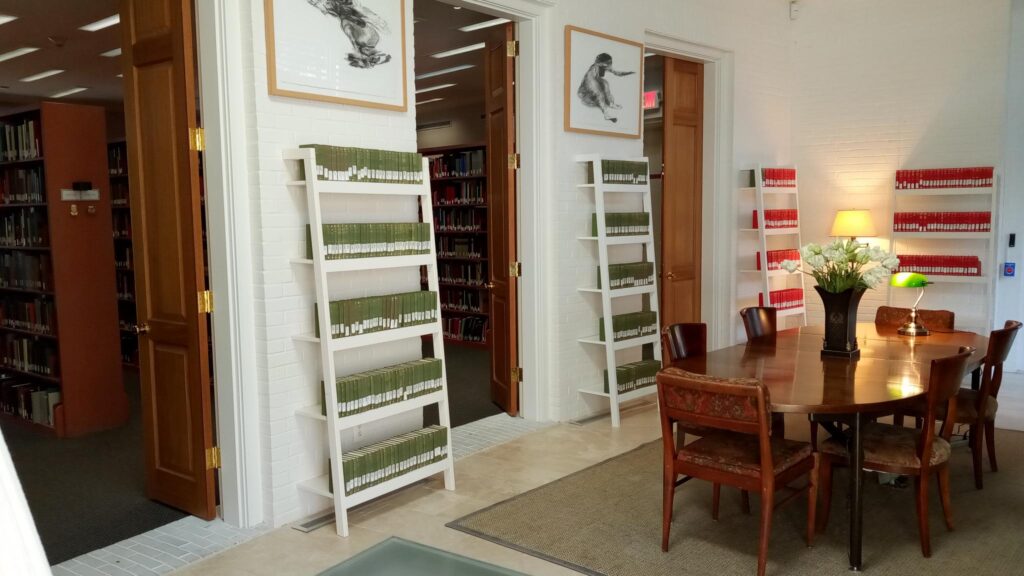
In addition to the Greek Loebs being interfiled by author, there is a separate set in the Mosaic Room upstairs. The latter is designated REF which means that they are to be used in the Mosaic Room for quick look-ups/reference, not taken to other parts of the library. Reference items should be easily available when you need to check, in this case, for example, the translation of a word or passage. There are also some Greek Budé, Teubner, and OCT volumes in the Black Classicists Room, also for reference. All these volumes should have a circulating copy in the stacks to be used anywhere in the library and also able to be checked out to offices and carrels.
Downstairs, one floor down: All other books, i.e., those with call numbers ranging from A through Z (with the exception of the PA’s). For those not familiar with the Library of Congress call no. system, here is a break down with further subdivisions: https://www.loc.gov/catdir/cpso/lcco/
Also, downstairs are the Epigraphy and Papyrology Reading Rooms. As the bookcase space is limited, not all books on epigraphy or papyrology are shelved there, mostly tools (e.g., indexes) and corpora (e.g., the Oxyrhynchus Papyri and the IG). The location code EPIPAP identifies these books in HOLLIS.
There is a Digital Humanities Lab next to the Epigraphy and Papyrology Reading Rooms. It houses equipment to access the library’s DVD and CD collections and a high-resolution scanner for, at the moment, an in-house digitization project.
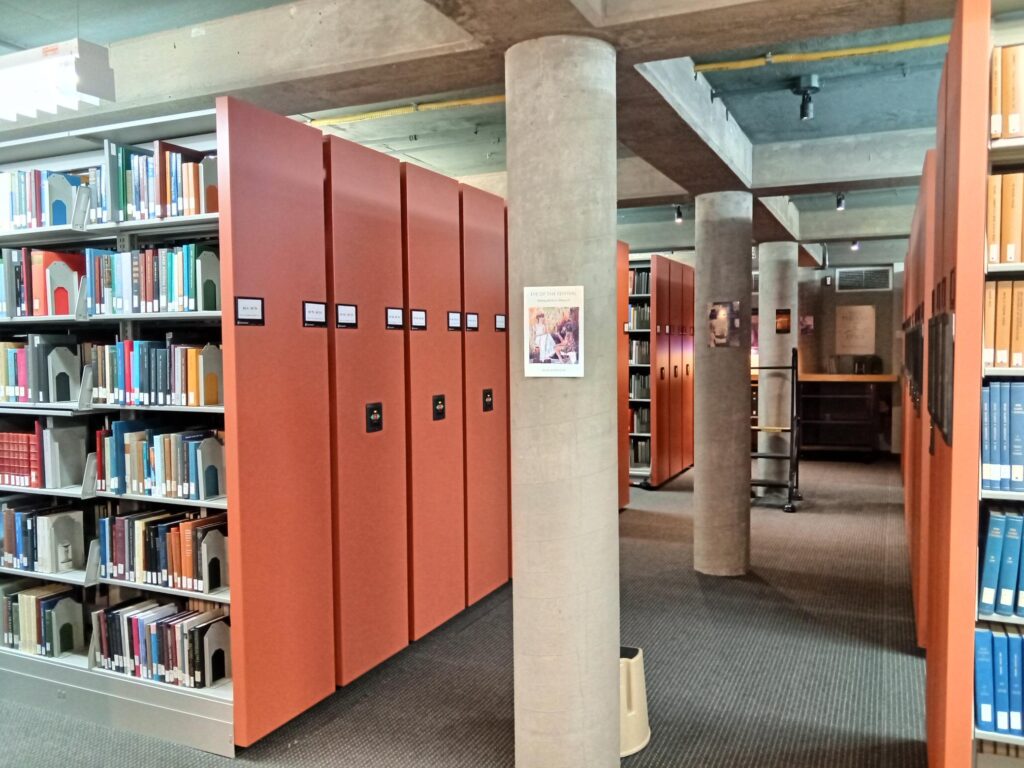
Also shelved downstairs are Folios (“smaller” oversize volumes) and Journals (the latter are in alphabetical order).
The Folios and Journals are located on compact (moving) shelves. Press the button to move to the left (to move forward in call number order) and to the right (to move backward in call number order).
Reference and Language Dictionaries and Oversize Books
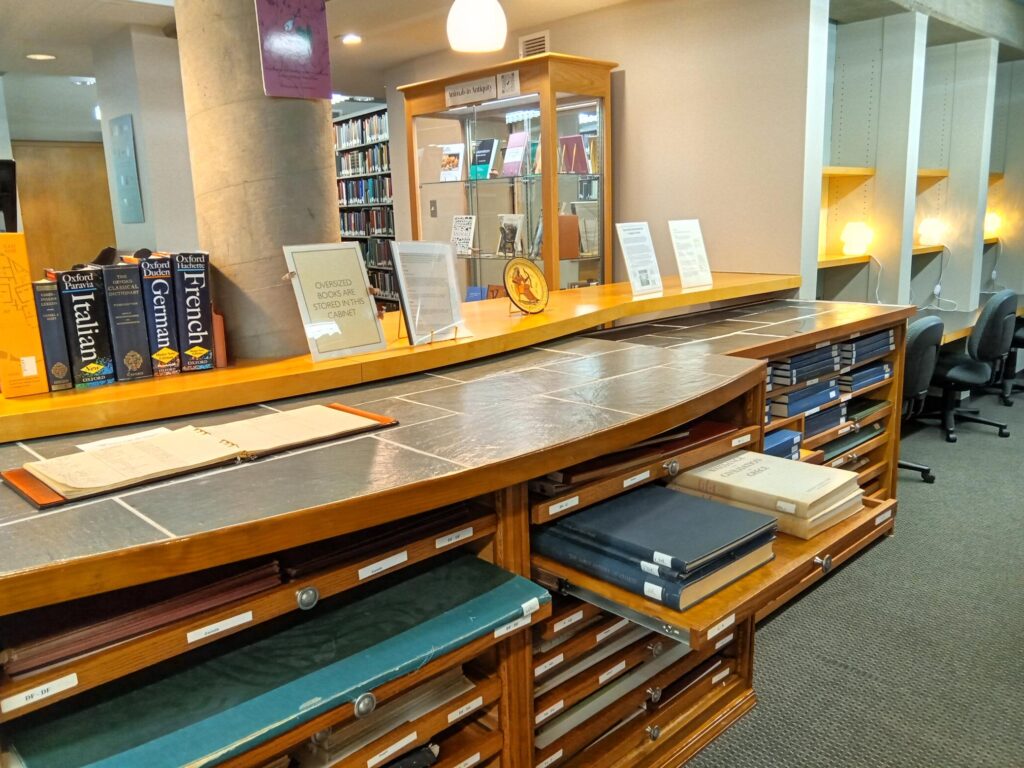
- Also shelved downstairs are some language dictionaries and reference books along the wall by the large table.
- Located on large oversize horizontal shelves in two cabinets by the carrels are atlases, art and archaeology materials (with plates, maps, diagrams of excavations at Ephesus, Delos, Athens, Delphi, Lesbos, Bassae, Corinth, Olympia, etc., Attic vase paintings, Beazley, Knossos Fresco Atlas, Evans);
- manuscript facsimiles such as the Cairo Codex of Menander (P. Cair. J.43227) which contains large sections of papyri with the Girl from Samos, the Girl with the Shaven Head, and the Arbitration (the original manuscript is housed at the University of Egypt; the facsimile was produced at the Institute of Classical Studies, University of London, 1978);
- and Aristotle’s Constitution of Athens (British Library Pap. 131), the facsimile was produced at the British Museum, 1891. Through papyrus reuse the manuscript and facsimile also contain parts of scholia for Callimachus’ Aetia and Demosthenes’ In Midiam;
- a facsimile from Leipzig, 1929, of the illuminated Codex Vaticanus Latinus 3868 of works by Terence (the original from the 9th century is held in the Biblioteca Apostolica Vaticana);
- a facsimile of Platonis Codex Parisinus A containing the last two tetralogies of Plato, including Timaeus, Critias, the Laws, and the Republic, and apocrypha;
- John Flaxman’s illustrations of scenes from the Iliad and the Odyssey, Hesiod’s Works and Days and the Theogony, and tragedies of Aeschylus. This edition is from Florence, 1826 (engraved drawings of the Iliad and the Odyssey by Tommaso Piroli based on Flaxman’s outline drawings were originally published in Rome, 1793; the Hesiod engravings based on Flaxman’s drawings were created by William Blake).
Access to Rare Books
- Rare books, including manuscript facsimiles and rare books in exhibitions, may be consulted by appointment only. Please contact the librarian, at rlindau@fas.harvard.edu, at least two days in advance. Appointments may be made for 9:00 am-4:00 pm, M-F.
- To search for rare books in the library catalog HOLLIS, limit your search to “Library Catalog” and to the “Center for Hellenic Studies,” then to publication years “1500-1800” in the Advanced Search module.
- The CHS library owns ca. 300 rare book titles. Some highlights include a limited-edition facsimile of Homer’s Iliad referred to as Venetus A. The facsimile was printed in Leiden, A. W. Sijthoff, 1901, with a preface by Dominico Comparetti. The original manuscript (Codex Venetus A, Marcianus Graecus 454, now 822) from the 10th century is in the Biblioteca Nazionale Marciana in Venice, and is considered the most authoritative manuscript for the texts of the Iliad, Life of Homer, and the Epic Cycle (minus the Cypria) with scholia, most likely at least in part going back to the Alexandrian librarian and scholar Aristarchus (2nd c. BCE). The CHS digitized the manuscript at Marciana as part of the Homer Multitext Project; The library also owns F. A. Wolfe’s Prolegomena ad Homerum from 1795, which can also be read online through the Internet Archive;
- Other rare book highlights include editions of a 1549 Galen (transl. into Latin by Janus Cornarius);
- a 1520 Lucan, note the effort to resemble a manuscript with vignette illuminations and texts with commentary around the text itself;
- a 1585 Tacitus, the printer Christophe Plantin (Plantinus) fled to Antwerp from Paris fearing being accused of heresy as printing texts not authorized by the Catholic Church could lend you in prison or worse; note also the printer’s device in the form of a compass and angels, and the motto “labore et constantia,” by work and steadiness, the life of a printer;
- a 1668 Arrian (translated from Greek into Latin by Nicholas Blancard);
- a 1618 Herodotus, Greek-Latin parallel text, (Henri and Robert) Estienne-Stephanus (Robert fled Paris for Geneva); notice the passage highlighter throughout the text in the form of a hand with a pointing finger; also the printer’s device in the form of an olive tree (tree of knowledge), male figure possibly Paul the Apostle; other devices include an olive tree with a serpent coiling around, and the motto noli altum sapere, “do not be high-minded” – Robert Estienne left the Catholic Church for Protestantism; he also founded modern Latin lexicography, the TLL);
- a 1593 Isocrates (Greek and Latin parallel text, Estienne);
- a 1585 Epictetus (Plantin);
- a 1549 Quintilian, printer Sebastian Gryphius (Sébastien Gryphe), Lyon, with a griffin on top of a winged globe as a printer’s mark; one of his collaborators in the print shop was burned at the stake for heresy.
If you own rare books, ancient coins, manuscripts with ancient texts, please think of donating them to our library where they will be housed in a humidity-controlled space, be appreciated and curated, and occasionally exhibited and consulted by scholars. The item(s) will be given a bookplate with your name if possible without adversely affecting the integrity of the item(s), a note in the Harvard library catalog HOLLIS, and the possibility of getting a tax deduction. Please note that we can only offer a letter listing titles donated, not an appraisal of their monetary worth (see the “Book Donations Policy” statement below). If this is of interest, please contact the librarian at rlindau@fas.harvard.edu or 202-745-4433.
Book Donations Policy
The Library of the Center for Hellenic Studies of Harvard University is happy to accept both monetary donations and gifts-in-kind, or non-monetary donations, which are compatible with the Library’s areas of collecting. We are particularly interested in rare and antiquarian materials but will also accept modern items as long as they are not already in our Library’s collection. To check our holdings, please search the Harvard Library Catalog, HOLLIS. There you may limit your search to “Library Catalog” and “Center for Hellenic Studies” to ascertain if we already own the book(s) being considered for donation.
The CHS Library assumes ownership of all donations and reserves the right to add donated materials to its collections or to possibly exchange, sell, or discard them as well as make decisions about their storage, location, processing, access, use, retention, and reformatting/digitization.
The appraisal and documentation of materials for tax purposes is the sole responsibility of the donor. Under Internal Revenue Service (IRS) regulations, a library is not permitted to appraise gifts. For tax purposes the CHS Library is happy to provide a receipt of acknowledgement with an inventory of items donated. The CHS Library cannot assign a dollar value to a book donation.
Donors should refer to the IRS’s Publication 561: Determining the Value of Donated Property for information on gift appraisals accepted by the IRS for tax purposes. The CHS Library does not pay for or reimburse such appraisals, nor does it authenticate the qualifications of appraisers or the validity of their appraisals. While the Library cannot recommend appraisers, these are some organizations through which potential donors may be able to locate appraisers in their geographic areas and subject specializations: American Society of Appraisers; Appraisers Association of America; International Society of Appraisers.
Self-Checkout
- Scan the barcode on your Harvard or CHS ID, lining it up with the infrared light. Then scan the barcode on the inside back cover of the book you wish to check out. Fellows have a checkout period of one semester (their entire stay) and can keep books in their offices. They can check out books 24 hours a day, including on holidays.
- Special loans allowing fellows to check out books to their residences on campus may occasionally be granted by the chief librarian to prepare for an imminent talk, a publication deadline, or the like.
- Readers can keep checked out books on designated shelves in the library. The checkout period is the duration of their stay as indicated on the application form, but no longer than until the end of the academic year in May when all books must be returned. Library reader access is 9am-5pm M-F except for on holidays when the library is closed.
- Both fellows and readers should try to limit their check-outs to one shelf at a time.
Check-in & Reshelving
- On the touch screen self-check-out/in kiosk, you choose “return” and scan the barcode on the inside back cover of the book to check it in. Once you have checked it in, the screen will say “returned,” which means that you can rest assured that the book has been removed from your account and will not generate an email asking you to return the book or impose a fine if it is past due.
- The library staff reshelve all items. Please place all checked-in books on the small shelves by the kiosks downstairs and upstairs in the library. If the designated shelving spaces are full, place the checked-in books on carts nearby.
“Scan & Deliver” and Interlibrary Loan (ILL)
Residential fellows and Harvard affiliated individuals with a Harvard Key can request a journal article or book chapter not owned by the CHS via the “Scan & Deliver” feature in HOLLIS. These items are subsequently scanned and sent to the inbox of the requester. For books, please contact the CHS librarian at rlindau@fas.harvard.edu. CHS library readers who need books or journal articles not owned by the CHS should check the library catalogs of other libraries in the DC area. If no library in the area owns an item, readers will need to visit the library of their home institution or, in the case of independent scholars, a public library, of which there are at least 15 in DC alone, for example, Georgetown Neighborhood Library, Cleveland Park Library, and Martin Luther King Jr Memorial Library, to request an interlibrary loan. The public library will then send the request to libraries in the country or elsewhere in the world. The borrower will be notified when the book has arrived, or if a journal article is needed, it will most likely be sent to the borrower’s inbox. The Library of Congress also provides interlibrary loan services for the public.
Missing Books & Book Purchase Recommendations
- Please alert the library staff if you cannot locate a book.
- If you have recommendations for books to purchase that fit the profile of the CHS collection, please contact the chief librarian.
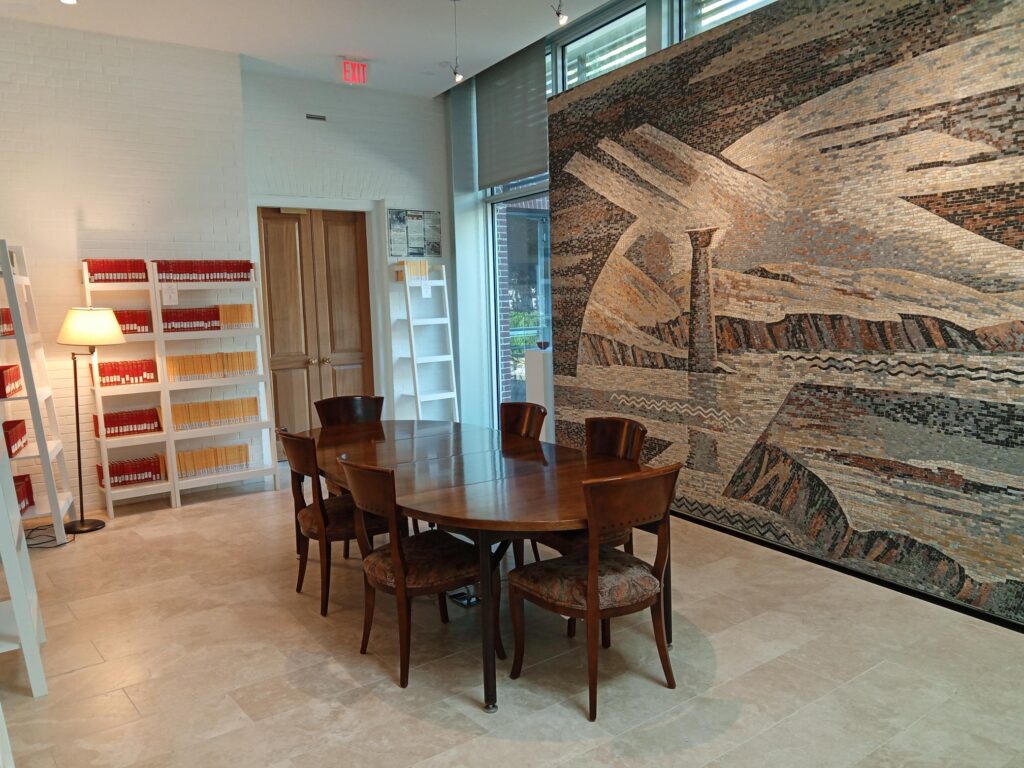
https://www-current.chs.harvard.edu/artist-anthony-schiavo-and-the-center-for-hellenic-studies-meiere-mosaics/ . The Mosaic Room also holds reference copies of the Loeb Classical Library editions.