Harvard University’s Center for Hellenic Studies was founded in 1960. It was made possible by a grant of the Old Dominion Foundation, the predecessor of the Mellon Foundation. The land on which the Center in Washington, DC was built was donated by Mrs. Marie Beale to the foundation, in memory of her son, Walker Blaine Beale, Harvard College class of 1918, who died in World War I. The gift was made “exclusively for the establishment of an educational center in the field of Hellenic Studies designed to rediscover the humanism of the Hellenic Greeks.” The Center’s administration was entrusted to Harvard University.
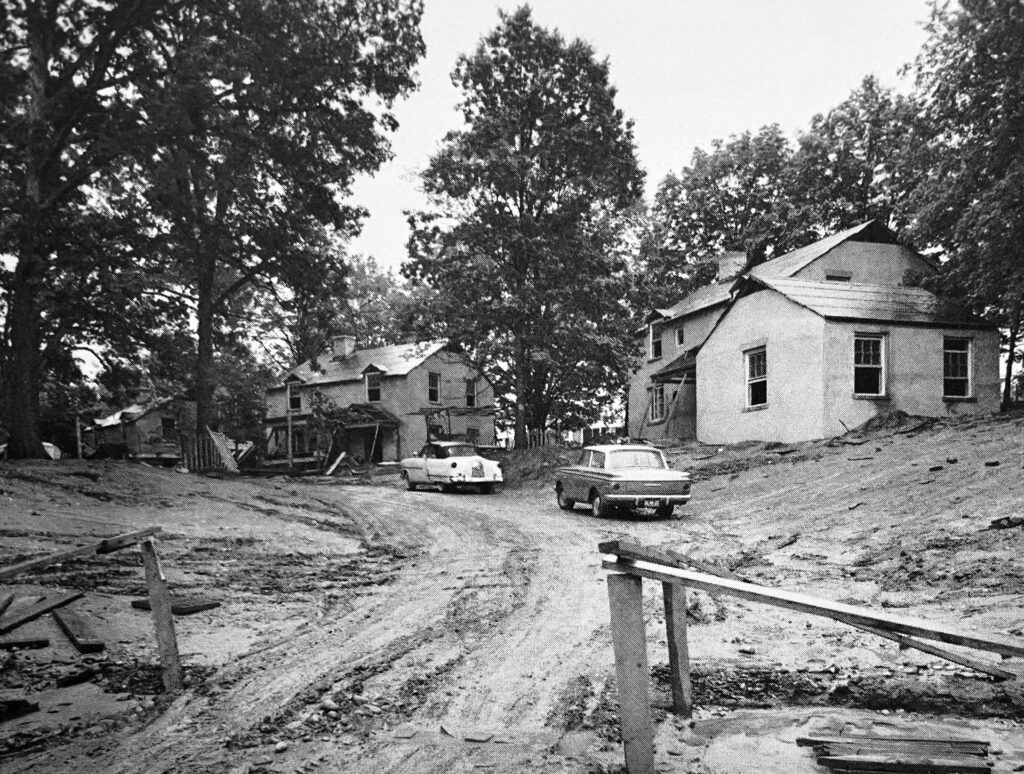
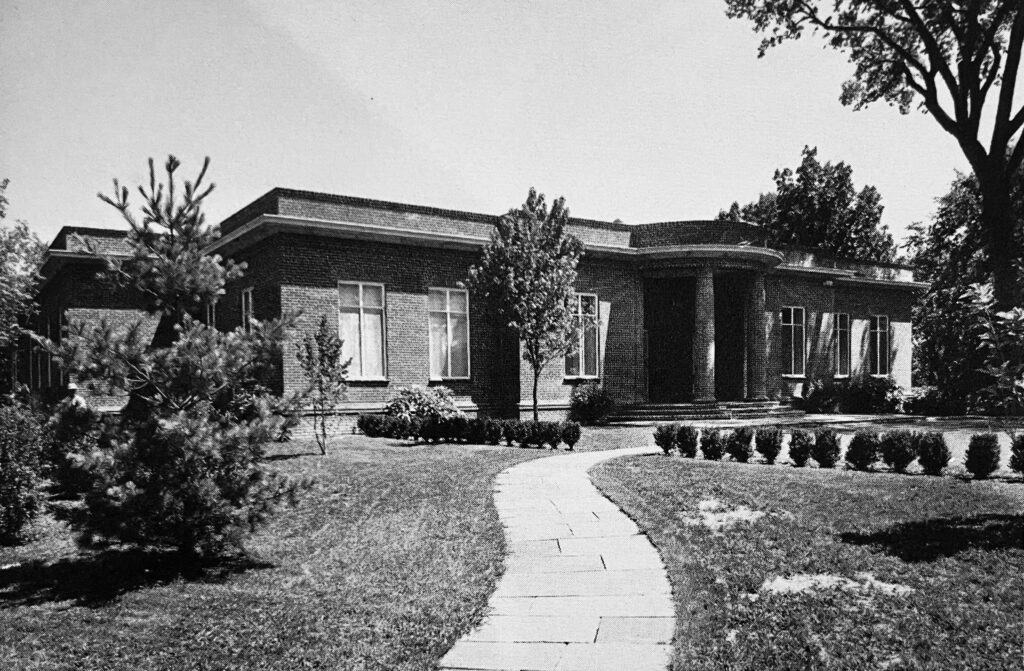
Page Cross, an architect based in New York, was hired to design the Center’s buildings at 3100 Whitehaven St NW. Cross’s design included accommodation for the Director and fellows and a central building with a library, administrative offices, and fellows’ studies, as well as a dining room and kitchen.
The Center was officially dedicated on May 14, 1963, with Paul Mellon and other dignitaries in attendance. At that occasion, Mellon and Bernard Knox, the Center’s first Director, expressed their hopes that the Center would serve as a model for other institutions and “give a fresh impetus but also a new direction to the study of Greek and hence to its effect on our own age.”
The Center’s Directors
After the Center’s establishment was announced in January 1961, Bernard Knox, then Professor of Classics at Yale University, was appointed its Director. Because of a previous commitment as Sather Lecturer at the University of California, Berkeley, his appointment was delayed by one year, during which Michael Putnam of Brown University served as Acting Director. Knox retired in 1985. He was succeeded by Zeph Stewart of Harvard University (1985–1992), Deborah Boedeker and Kurt Raaflaub of Brown University (1992–2000), Gregory Nagy of Harvard University (2000–2021), and Mark Schiefsky of Harvard University (2021–2026). The current Director of the Center is Naomi Weiss of Harvard University.
The Fellows
The first group of residential fellows arrived in 1961 just as construction was starting. They had studies in a house owned by Paul Mellon on Whitehaven Street, but they had to live elsewhere in Washington, DC. The following year, fellows were able to move into the newly built accommodation at 3100 Whitehaven Street.
From 1962 to 1992, the number of residential fellows was eight. In 1993, the number was increased to ten; in 1998, to an average of twelve. Now, there are about 24 residential fellows in total each year. Some stay for the full academic year, but the majority for just one semester. The Center also hosts summer fellows for month-long stays. Roughly half of the fellows have been American citizens; the others have come from about thirty other countries, with the United Kingdom, Germany, Italy, and Greece sending the largest contingents.
The Library
The Center’s architectural focus is the building that houses the library. Initially, the library held just a handful of books. Michael Putnam, Acting Director of the Center during its first year, wrote to Blackwell’s in Oxford asking if they knew of any private libraries for sale, stating, “what we really most need is a first-rate nucleus of the basic texts, commentaries and reference works. I don’t envision another Bodleian or a Widener. Still, we want a good working library, cutting as broad a swathe through the various disciplines as possible.” In the autumn of 1961, Werner Jaeger, professor at Harvard, suddenly died. His widow allowed the CHS to acquire his large library, including several antiquarian books. By the end of 1962, Jaeger’s book collection was available to the fellows in Washington. Soon other private libraries were added such as those of Harvard professors Arthur Stanley Pease and Arthur Darby Nock. In 1971, Bernard Knox wrote, “at the threshold of its tenth year of existence the Center can take pride in the building of a library which in spite of its late beginning is adequate in most of the many branches of discipline it represents and more than adequate in some.” The Center’s first librarian was Jeno Platthy, recruited from Harvard’s Widener Library.
In 1963, the library’s collection comprised roughly 10,000 volumes. By 1986, its holdings had increased to about 43,000 volumes; today, they number approximately 75,000. The areas of collecting have expanded to include selective coverage in art, archaeology, numismatics, paleography, Roman studies, and reception studies, adding to the comprehensive collecting of publications in ancient Greek philology, history, philosophy, science, epigraphy, and papyrology. The library also provides access to many online publications for CHS fellows and Harvard faculty, staff, and students.
Expansion of the Center
In 1998, the Center completed a major expansion of its library, office, and storage space. An ongoing program of broadening the scope of the Center’s library was then accelerated: art and archaeology as well as numismatics, initially considered secondary in the Center’s priorities, received more attention, while the collection in Roman studies, important for comparative purposes, was also considerably strengthened. Since the mid-1990s, at least one archaeologist or art historian has usually been among the fellows, and interdisciplinary projects can be served better than before.
When Gregory Nagy was appointed Director in 2000, he envisioned a more international profile for the Center. CHS Greece was founded in June 2008 by way of a joint decision between the Provost and the Dean of the Faculty of Arts and Sciences at Harvard University. Housed in the historic Iatrou building in Nafplio, it is both a sister campus for the Center in Washington, DC and one of Harvard’s global offices. From its inception, CHS Greece was designed to be accessible to the general public. Its goal is to provide educational opportunities both to the Harvard community and to the local Greek and wider global communities.
Publications on the Center’s History
Two publications document the Center’s early history: Addresses Delivered at the Center for Hellenic Studies (Washington, DC 1963); Eric N. Lindquist, The Origins of the Center for Hellenic Studies (Princeton 1990).