
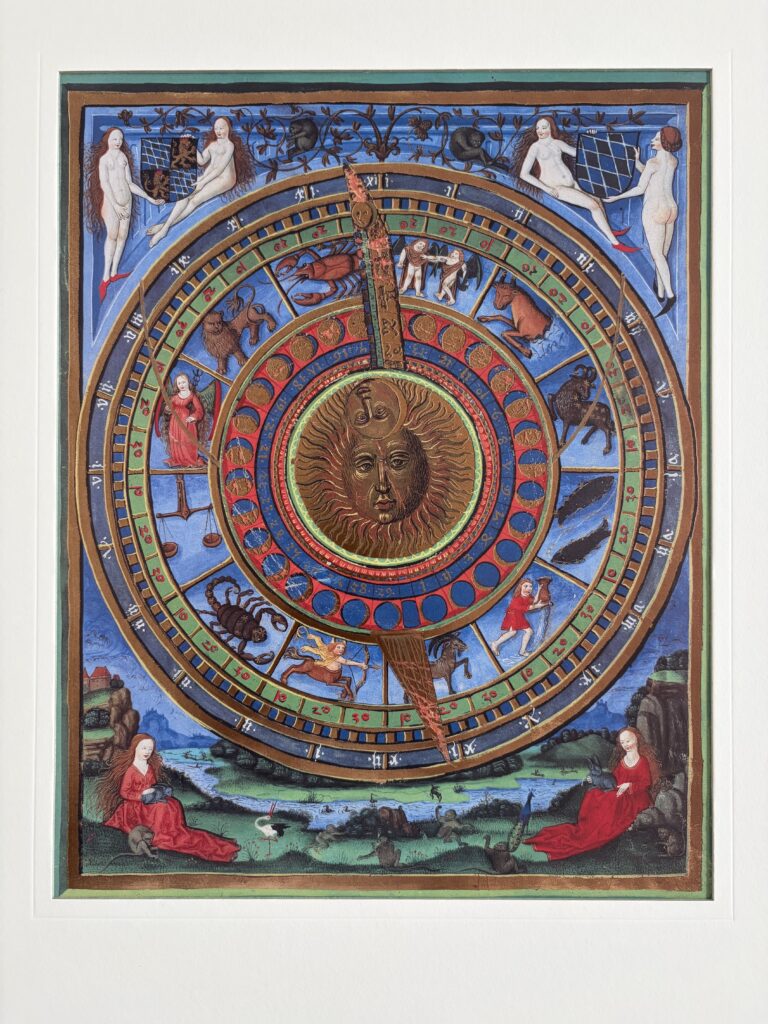
In connection with the acquisition of facsimiles of some noteworthy medieval illuminated manuscripts dealing with astrology, Tejas S. Aralere, residential fellow 2025-2026 and assistant professor of classics and the humanities at the University of New Hampshire, introduces us to Yavana Jātaka, a 2nd-cent. CE Sanskrit astrological treatise often translated as the “Greek Horoscopy” because it appears to be the earliest source translating the Graeco-Babylonian zodiac into Sanskrit, preceded by an introductory section on ancient Greek astrology by Rebecka Lindau, followed by descriptions of the items acquired for the CHS library.
Ancient Greek Astrology and Noteworthy Additions in the CHS Library
In the royal courts of ancient Mesopotamia, astrologers observed, analyzed, and predicted weather phenomena and plagues and famines, wars and the outcomes of wars, and even the death of rulers, used similarly as divination and the study of omens. Several papyrus fragments with ancient horoscopes have survived and in cuneiform texts as well (see a clay tablet from Uruk below). The oldest extant horoscope (for the year 410-409 BCE) was made in cuneiform script in Babylon and there are ostraka in Demotic (Egyptian) from ca. 250 BCE to 132 CE describing the alignment of the gods to the planets and the zodiac with its 12 signs, i.e., the particular star clusters along the path of the sun’s ecliptic. These 12 signs, slightly modified in appearance, made their way into ancient Greek and Roman astrology, and remain in use today.
Many of the greatest Greek scientists and philosophers of antiquity including Plato, Aristotle, Euclid, Archimedes, and Ptolemy referenced astrological observations in their examinations. Around 700 BCE, the Greek poet Hesiod wrote Theogony in which he explained the origin of the world and the significance of the gods and their genealogy in it (Hesiod is also said to have written a now lost poem “Astronomia” which is referenced in Hyginus’ De astronomia). According to Callimachus (Ep. 27), Hesiod’s work influenced Hellenistic poet Aratus (ca. 315/310–240 BCE, see below the description of the Leiden Aratea) and his stellar myths. Both works described a universe with stars and planets ruled by gods. Several star constellations bear names derived from Greek and Roman mythology, Orion, Cassiopeia, Pegasus, Andromeda, Castor and Pollux, and the Romans named the planets after their gods as did later scientists as new planets were discovered, Mercury, Venus, Mars, Jupiter, Saturn, Uranus, and Neptune, including the now demoted Pluto. From seeing gods in stars and planets the leap is not far to believing that the constellations, just like the gods, ruled human affairs.
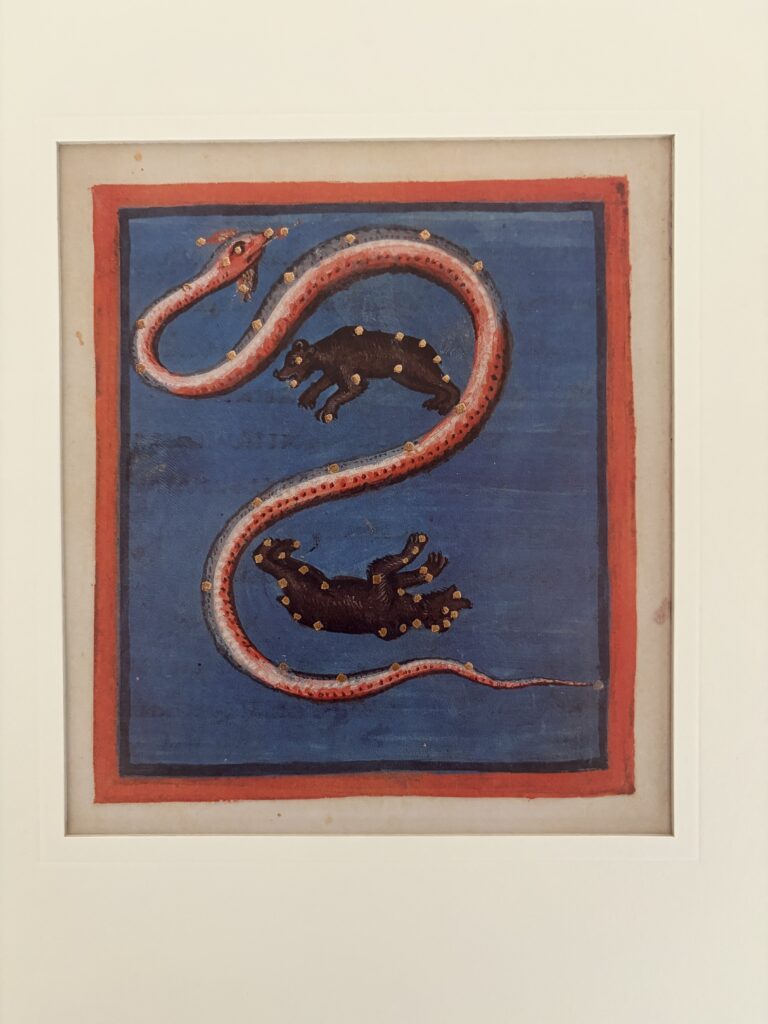
“Ursa Major et Ursa Minor” (The Big Bear and the Little Bear), Leiden Aratea (9th Century) – Leiden, Bibliotheek der Rijksuniversiteit Leiden, Ms. Voss. Lat. Q. 79. Digital version. Leaf, CHS facsimile.
This is a collection of ancient and medieval astronomical texts based on the Phaenomena, a 3rd-century BCE didactic poem by the Greek poet Aratus which describes the constellations and celestial phenomena known at the time, according to which the cosmos was a universe ruled by the gods. Aratus’ text was translated into Latin by Cicero. He drew upon a text by the Greek natural philosopher and mathematician Eudoxus of Cnidus, which also bore the title Phainomena, as a source. He is said to have used a celestial globe, marked with the positions of the stars, for his observations. After an introductory hymn to Zeus, Aratus describes the fixed stars, the celestial circles (the equator, the zodiac, and the tropics), the twelve signs of the zodiac, the movements of the sun and moon, and their influence on human affairs. A second section deals with weather signs. For Aratus, the celestial sphere, upon which the constellations were fixed, rotated around an axis with a consistent north-south orientation. The earth was fixed at its center and surrounded by the spheres of the seven known planets and the fixed stars. The two she-bears approach Zeus/Jupiter who found refuge as a child in a cave on Mount Ida on Crete, away from his father Cronus. Cronus sought to kill him, fearing he would be overthrown by his own son. The serpent, the constellation Draco, played an important role. After Zeus’ mother had hidden him in the cave of the Bears, he transformed into a serpent. In gratitude for his rescue, Zeus later placed the Bears among the stars in the heavens. The serpent points its head toward the celestial pole and revolves around the celestial axis. Together, the Bears and the serpent form the constellation the Big Bear (often associated with the Big Dipper). Along with the Pole Star, this served as a crucial navigational reference point at night for seafarers (from Von den Gestirnen: Meisterwerke zur mittelalterichen Sternenwelt, Coron, 2022).
Astrology, the study of the stars, was developed by the Babylonians who along with the Sumerians based time on lunar cycles, the phases of the moon, and by the Egyptians who used a solar calendar, also the basis for the Julian and the current western Gregorian calendars. For the ancient Greeks, too, the sun was the center of time (though not the universe; for the slightly more complicated picture (Aristarchus of Samos, Seleucus of Seleucia), see an earlier blog post, “The Beauty of Geometry”) although the Greek calendar was a combination of lunar and solar (note that there was no standardized Greek calendar as it differed among city-states). The earliest Roman calendar, before the Julian, was lunar just like the Mesopotamian one. Stoic philosopher Cleanthes (ca. 330-ca. 230 BCE) called the sun the authoritative principle of the world even though he reportedly wanted to indict his contemporary Aristarchus of Samos, famous for his heliocentric view of cosmos (Plutarch, De fac. (On the Face in the Moon) 6.922f–923a). Believers in fate, the Stoics embraced divination of all kinds, including astrology, and revered the stars, especially the sun. The pre-Socratic philosopher Heraclitus (6th-5th c. BCE) is quoted in Plotinus’ Ennead as saying, “the sun too is a god, for it has a soul, as well as the other heavenly bodies, and above all we [humans] too,” ἔστι δὲ καὶ ἥλιος θεός, ὅτι ἔμψυχος, καὶ τὰ ἄλλα ἄστρα, καὶ ἡμεῖς.
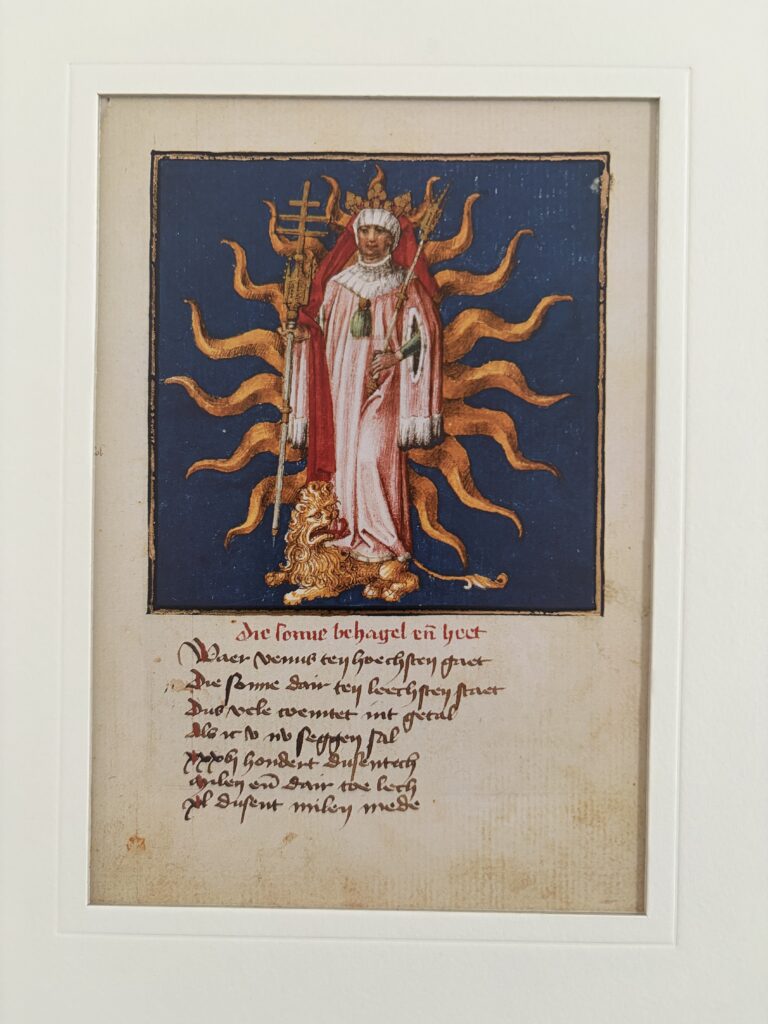
“Die Sonne,” Natur des Weltalls (Utrecht, 1465-70) – Wolfenbüttel, Herzog August Bibliothek. Leaf, CHS facsimile.
Among the curiosities of this work is a bifolium containing medical recipes in Latin as well as instructions for bloodletting, accompanied by an explanatory drawing of a “bloodletting man” (a diagram indicating appropriate sites for the procedure). This suggests that the manuscript originally belonged to the medical section of a monastic library. It was most likely produced for someone with an interest in astronomy and medicine. However, the combination of these two subjects may also stem from the widespread belief in the influence of celestial bodies on human health; a physician was expected to be well-versed in astrology given that certain medical procedures were considered more effective when performed under specific planetary alignments or on particular days. Twenty gold-framed miniatures depict the twelve signs of the zodiac (fol. 139v-15Ir), five planets (fol. 123v-126v) as well as the figures of the sun (fol. 125r) and the moon (fol. 123r). These are complemented by a series of smaller cosmographic drawings. The planets Mercury, Venus, Mars, Jupiter, and Saturn are rendered as the eponymous gods from classical antiquity. The waxing and waning moon is associated with the figure of Fortuna, a symbol of the fickle nature of fate. The planet Mercury shows the god of commerce as a money changer. Mars, the god of war, is depicted as an armed knight on horseback with a flaming helmet. Jupiter, unusually, holds a harp in his hands. Saturn, the planet of misfortune and time, is depicted as a downtrodden peasant. The Sun figure (fol. 125r) stands in the form of a ruler at the center of the image. The Sun is surrounded by a radiant yellow sun like a mandorla. On its head is a crown, and in his hands he holds a cross-staff and scepter, the symbols of ecclesiastical and secular power. Beneath his feet, is a lion, which symbolizes royal power. The lion also refers to the constellation named after it. The figure of the Sun stands against a flat, dark blue background, which suggests the sky (from Von den Gestirnen: Meisterwerke zur mittelalterichen Sternenwelt, Coron, 2022).
Interpreting and predicting earthly and human events from the alignments of the fixed stars, the sun, the moon, and the planets became popular especially during the Hellenistic period and in Rome both in the late Republic and the Empire. Emperor Augustus, for example, who published his horoscope, strengthened astrology’s hold on the Romans and legitimized it as an acceptable form of divination, simultaneously banning astrological death predictions such as that of his great-uncle Julius Caesar and the astrological “Ides of March,” i.e., the first full moon of the new year according to the early Roman moon calendar.
The Zodiac
The mathematical calculations with grids, charts, planetary tables, and commentaries could be quite intricate, involving determining the boundaries of the 12 zodiac sign constellations and the longitudes and latitudes of the seven recognized planets (from the Greek πλανήται, “wanderer” stars) at a specific place and time against the backdrop of the sphere of fixed stars. This calculation was understood by examining the geometric interrelationships of the signs and their parts and of the planets and by associating them with each element in an astronomical chart, a horoscope (“hour observing”). In addition to the signs of the zodiac (from the Greek ζωδιακός κύκλος “circle of animals” since many of the star constellations through which the sun’s ecliptic passes represent non-human and human animals), other star clusters, planets, the sun and the moon and their various relationships in the zodiac were analyzed. The 12 signs were divided into four groupings of three (a triplicity) separated by 120 degrees along the path of the ecliptic, each of which governed one of the four elements (air, fire, water, earth) and was believed to share traits and temperaments, i.e., among those born in the earth, water, fire or air signs.
Origins
Astrology was for at least a couple of thousand years a respected teaching. With the heliocentric world view it became relegated to a pseudo-science, and astronomy, the “measuring” of the stars, became the respectable and acceptable manner with which to study the stars and the planets. In Hellenistic Greece the terms were often used interchangeably. The Pauly-Wissowa lists several terms for astrology, ἀστρολγία, ἀστρομαντεία, ἀστροσκοπία, γενεθλιακή, γενεθλιαλογία, μαθηματική, Χαλδαϊκή, ὡρονομική, ὡροσκοπική. For astronomy it lists ἀστρονομία and ἀστρολγία. Aristophanes used the word μετεωροσοφιστής, i.e., a sophist who observes celestial phenomena, to refer to an astrologer (Aristoph. Nub. 360) (μετέωρος, high, τὰ μετέωρα, celestial phenomena, and σοφιστής, expert, sophist). Later Greek authors such as Diodorus Siculus (1st c. BCE) and Josephus (37–ca. 100 CE) used the word ἀστρολόγος. The term in Latin was astrologus but also mathematicus (also in Greek μαθηματικός) or Chaldaeus (also in Greek Χαλδαϊκός) (i.e., (Semitic) Mesopotamian), see, for example, Roman satirist Juvenal (ca. 55–128 CE) who turns from the “charlatans” of the Circus Maximus to Phrygian or Indian soothsayers “skilled in the stars and the heavens… they have even greater faith in the Chaldaeans,” Chaldaeis sed maior erit fiducia (6.553). The Greek geographer Strabo (64/63 BCE–ca. 24 CE) refers to Cynic philosopher Bion as an astrologer (“Βίωνα τὸν ἀστρολόγον,” Geography 1.2.21) even though Bion is known to have satirized astrologers along with the gods.
Roman author and statesman Cicero (106–43 BCE) in his rather devastating rejection of astrology wrote,
“Let us come to Chaldean manifestations. In discussing them, Eudoxus [of Cnidus in the 4th century BCE, astrologer/astronomer, mathematician, Plato’s disciple and Aristotle’s teacher at the Academy], whom the best scholars consider easily the first in astrology (astrologia), has left the following opinion in writing: ‘No reliance whatever is to be placed in Chaldean astrologers when they profess to forecast a man’s future from the position of the stars on the day of his birth.’ Panaetius, too, who was the only one of the Stoics to reject the prophecies of astrologers…” (Cicero, de divinatione 2.47, LCL trans.).
Josephus (37–ca. 100 CE) credits the Chaldaeans (Semites in southern Mesopotamia) with transmitting the teaching of astronomy/astrology to the Greeks via Egypt,
“for before the coming of Abraham the Egyptians were ignorant of these sciences [astronomy/astrology and philosophy], which thus traveled from the Chaldaeans into Egypt, whence they passed to the Greeks,” πρὸ γὰρ τῆς Ἁβράμου παρουσίας Αἰγύπτιοι τούτων εἶχον ἀμαθῶς· ἐκ Χαλδαίων γὰρ ταῦτ᾿ ἐφοίτησεν εἰς Αἴγυπτον, ὅθεν ἦλθε καὶ εἰς τοὺς Ἕλληνας (Jewish antiquities 1.168, LCL trans.).
Diodorus Siculus, though, says that the Egyptians learned astrology from a Greek, Actis, one of the Heliadae, who after killing one of his brothers escaped to Egypt where he founded Heliopolis, “it was from him (Actis) that the Egyptians learned the laws of astrology,” οἱ δ᾿Αἰγύπτιοι ἔμαθον παρ᾿αὐτοῦ τὰ περὶ τὴν ἀστρολογίαν θεωρήματα (5.57.3).
However, elsewhere Diodorus Siculus claims that the Egyptians invented astrology, not the Chaldaeans or Actis.
“…For the positions and arrangements of the stars as well as their motions have always been the subject of careful observation among the Egyptians, if anywhere in the world; they have preserved to this day the records concerning each of these stars over an incredible number of years, this subject of study having been zealously preserved among them from ancient times, and they have also observed with the utmost avidity the motions and orbits and stoppings of the planets, as well as the influences of each one on the generation of all living things—the good or the evil effects, namely, of which they are the cause. And while they are often successful in predicting to men the events which are going to befall them in the course of their lives, not infrequently they foretell destructions of the crops or, on the other hand, abundant yields, and pestilences that are to attack men or beasts, and as a result of their long observations they have prior knowledge of earthquakes and floods, of the risings of the comets, and of all things which the ordinary man looks upon as beyond all finding out. And according to them the Chaldaeans of Babylon, being colonists from Egypt, enjoy the fame which they have for their astrology because they learned that science from the priests of Egypt” (1.81.4-5, LCL trans.).
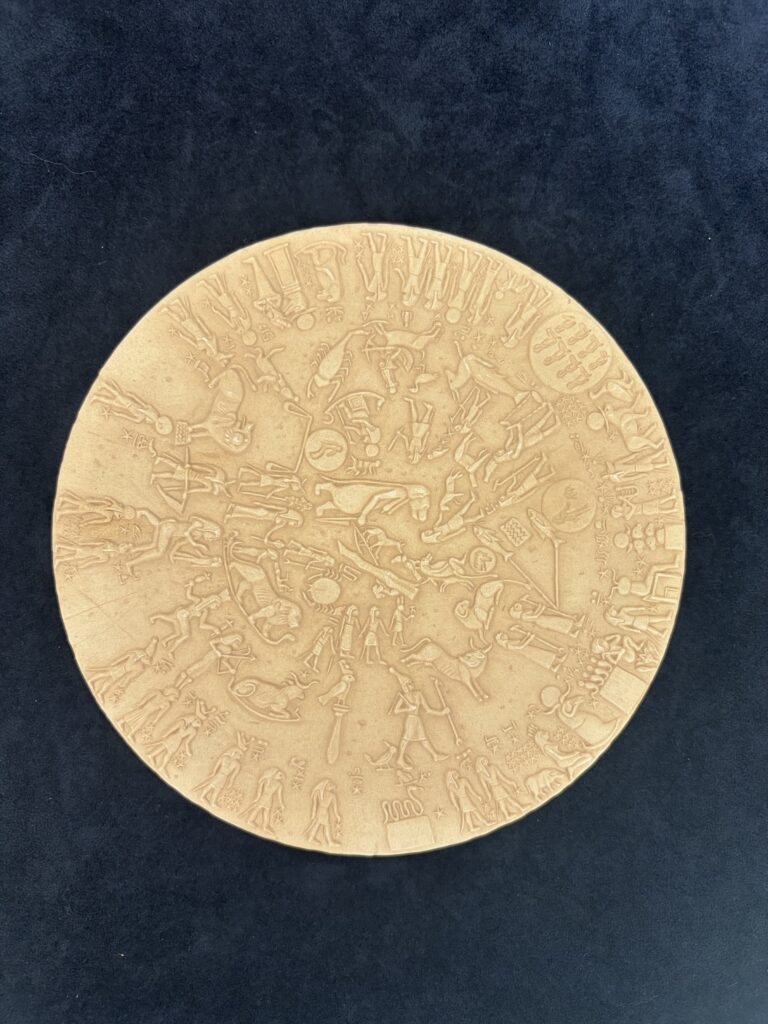
The Dendera Zodiac. The original of this celestial image is a relief in the ceiling of the Osiris Chapel in the Hathor Temple at Dendera, Egypt. For more information, see. Cover, CHS facsimile.
The Dendera Zodiac depicts the celestial sphere on a flat plane, a form known as a planisphere, and was created around 30 BCE. The relief displays a blend of celestial imagery derived from Egyptian, Greek, and ancient Near Eastern sources. The zodiac is arranged in a spiral pattern, with no dividing lines between the individual figures. Starting from the constellation of Cancer, which marks the beginning of the Egyptian year, located roughly in the center of the circle, the remaining signs of the zodiac follow in a clockwise direction, corresponding to the order of their appearance in the sky. In the center there is a snake where the celestial pole should be. Below it is a round crab(?), Cancer. Following that, standing on a boat, is a lion (Leo). Virgo stands behind him with an awl in her left hand. Libra, recognizable by its two scales. Scorpio is depicted more like a crab. After that comes Sagittarius with a bow. Capricorn lies directly behind it, its body in the shape of a goat-fish. Aquarius pours water from two bowls into a river, presumably the Nile, in which fish swim. The zodiac sign of Pisces follows, somewhat closer to the center. Two fish are joined at their tail fins, between them lies a pool of water with wavy lines. The ram (Aries), which according to western tradition would be first named in the order, is depicted lying down with its head turned back. Meanwhile, the bull (Taurus) appears to be leaping out of the circle. The circle is completed by the twins (Gemini), hand in hand as man and woman, and dressed in Egyptian style. Beyond this familiar zodiac, in the inner and outer circles, are a series of beings from the Egyptian pantheon. The large figure in the center of the circle with the stake is Taweret, the hippopotamus goddess. Anubis, the jackal with the plow and the animal on top of the bull’s thigh immediately beside it represents the Big Dipper. Above the signs of Pisces and Aries there is an eye within a disk; above that, a crouching monkey with a crowned sparrowhawk perched on its head, and, back-to-back with it, a dog facing upwards. This composition likely corresponds to the constellations Andromeda, Perseus, and Cassiopeia. Between Taurus and Gemini is a lion-headed man wearing a double crown, holding a long neck topped with a goat’s head; these correspond to the constellation Auriga (the Charioteer) with the star Capella. Above the zodiac sign of Leo sits a crowned man holding a whip, representing the constellation Leo Minor. Above Libra is a seated figure within a disk, with a fox or jackal above it, Ophiuchus (the Serpent Bearer). Above Sagittarius is a goose, and above that, a man holding a staff, Aquila (the Eagle) and Lyra (the Lyre). Above Aquarius, a headless, giraffe-like animal; above it, a four-legged animal being grasped by the head by a man. These likely represent the constellations Pegasus, Cygnus (the Swan), and Cepheus. Within the same circle, situated between the constellations, the planetary deities are also depicted as figures. Thus, the eagle-headed Jupiter can be identified between Gemini and Cancer, while the human-headed Mercury appears above Leo Minor. Saturn, with the head of an ox, is found between Virgo and Libra; the eagle-headed Mars is positioned above Capricorn; and the two-headed figure of Venus appears between Aquarius and Pisces. The next outer circle displays mostly divine figures from the Egyptian pantheon. Foremost among them, positioned directly opposite the hippopotamus goddess, is the “Triad of Dendera,” known in the Egyptian tradition as “the Lords of the Beginning of the Year.” These deities are Osiris, Horus (represented as the Horus-falcon on top of a lotus column, and Isis depicted as the celestial cow goddess Sopdet). Associated with them are the celestial bodies Orion, Phoenix, and Sirius (from Von den Gestirnen: Meisterwerke zur mittelalterichen Sternenwelt, Coron, 2022).
Ptolemy’s Tetrabiblos
The Alexandrian (Egyptian-Greek-Roman) astrologer and astronomer, music theorist, geographer and mathematician Ptolemy (ca. 100–170 CE) emphasized the importance of calculating the precise degree of the ascendant planet at birth. Ptolemy addressed the question of the earth’s position within the structure of the universe and concluded that it remained stationary and formed the center of the cosmos. Based on this geocentric worldview, he described, in thirteen books, theories regarding the sun and the solar year, the cycles of the moon, and the sphere of fixed stars, detailing over a thousand stars and 48 constellations with their coordinates.
“Of the means of prediction through astronomy, O Syrus, two are the most important and valid. One, which is first [astronomy] both in order and in effectiveness, is that whereby we apprehend the aspects of the movements of sun, moon, and stars in relation to each other and to the earth, as they occur from time to time; the second [astrology] is that in which by means of the natural character of these aspects themselves we investigate the changes which they bring about in that which they surround. The first of these, which has its own science, desirable in itself even though it does not attain the result given by its combination with the second, has been expounded to you as best we could in its own treatise [Almagest] by the method of demonstration. We shall now give an account of the second and less self-sufficient method in a properly philosophical way, so that one whose aim is the truth might never compare its perceptions with the sureness of the first, unvarying science…” (Ptolemy’s introduction to Book 1 of his Tetrabiblos, LCL trans.).
Ptolemy’s Tetrabiblos offers probably the best early account of ancient Greek astrology as a practical application of astronomy. Ptolemy’s defense of astrology presents a mixture of Aristotelian and Stoic philosophy, and the Platonic view that the soul comes from the heavens which explains how human character comes to be determined by the heavens (see, e.g., Tetrabiblos 3.13). With the translation of the Tetrabiblos into Latin in the 12th century, “Ptolemaic astrology” became integrated into medieval Christian doctrine by such scholars as Origen and Thomas Aquinas (though receiving condemnation from Augustine, Jerome, Chrysostom, Ambrose, and Eusebius) which promoted its popularity and even acceptance of “Ptolemaic astrology” at the university (Pope Leo X (1475-1521) even endowed a chair in astrology at La Sapienza) especially with regard to the humors associations which derive from their relationship to the sun, and the four “Aristotelian qualities” (hot, cold, wet, and dry) as the heating, cooling, moistening, and drying effects of the atmosphere with regard to the celestial body, and the study of medicine. Astrology exerted significant influence on the medical practice of the Middle Ages. In Hellenistic times and later each zodiacal sign was assigned a special relationship to parts of the human body. A prime example is the widespread use of bloodletting, a procedure that was to be performed at specific points on the human body only on days deemed “favorable” according to the lunar phases and the relevant zodiac signs (see below; see also Tejas Aralere’s piece after the introduction to Greek astrology).
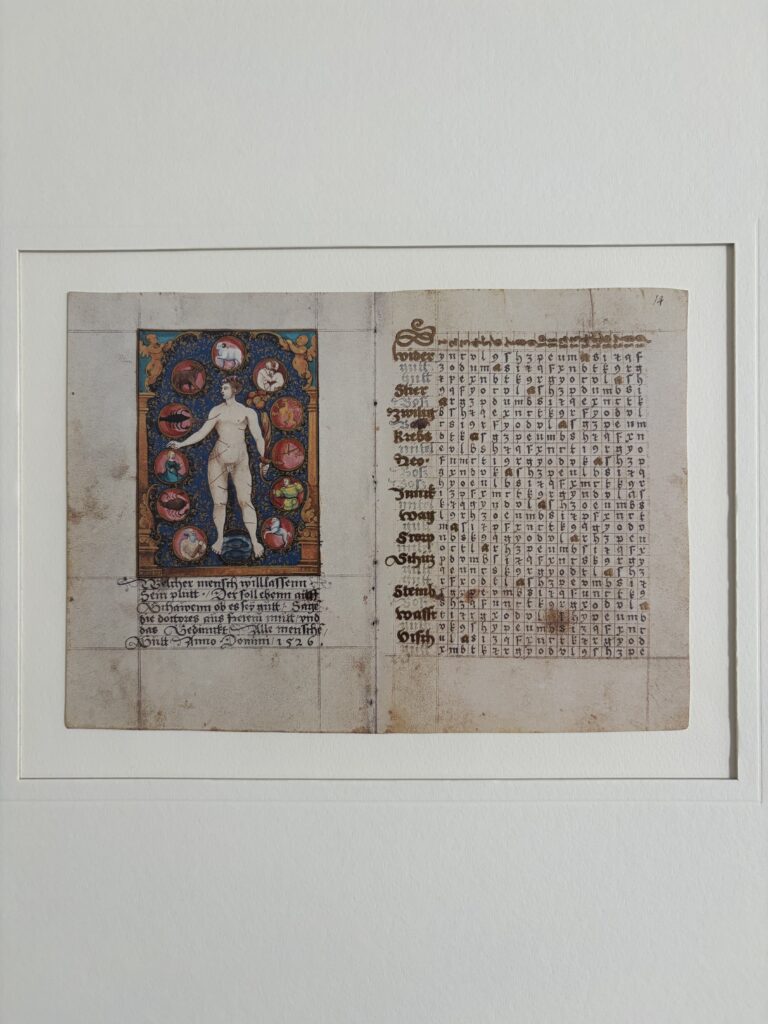
“Tierkreiszeichen-mensch” (Zodiac man), Glockendon Calendar (1526) – Berlin, Staatsbibliothek Preussischer Kulturbesitz, Ms. Germ. Oct. 9. Digital version. Leaf, CHS facsimile.
A calendar for the year 1526. It contains miniature paintings of the months accompanied by poetry, the signs of the zodiac, and the saints of the day. It also contains descriptions of bloodletting, the moon phases, and a discussion about determining the “Golden Numbers” for astronomical calculations (see below). Glockendon was the name of a Nuremberg family whose workshop produced various types of artistic crafts during the early 15th century. Albrecht Glockendon was known both as a painter of miniatures and illuminated letters and as a cutter of woodblocks. He identified himself as the artist behind this calendar by inscribing his name and the date on one of the manuscript’s folios. The calendar concludes with the double page shown here (fol. 13v/14r). On the left is zodiac man and on the right is a bloodletting chart. On the left, in an image surrounded by columns, stands a naked man, encircled by twelve medallions with the signs of the zodiac. Red connecting lines run from each sign to the man’s naked body. These lines indicate the places where blood was drawn during the time of the corresponding zodiac sign. Starting at the head of the man with the ram from left to right and top to bottom, i.e., Aries, Taurus, Gemini, Cancer, Leo, Virgo, Libra, Scorpio, Sagittarius, Capricorn, Aquarius, and Pisces. The right side shows a bloodletting table. In the first column, the signs of the zodiac are listed from top to bottom in the order of their appearance in the sky. The title row, written in gold, contains the numbers 1 to 19; the 19 years of a solar year. Below, again in columns from top to bottom, are 27 characters each, consisting of the alphabet a-z, including the letters for s and v and the syllabic letters for et and con. If one could determine the Golden Table using a different representation of the calendar, it would be possible to identify the auspicious and inauspicious days for bloodletting in the current year. The depiction of the zodiac sign or bloodletting man is considered a particularly memorable composition from the Middle Ages. The stars and planets were imagined as parts of the body. At the time of the world’s creation, the constellation Aries was believed to have stood at the “head” of the cosmos, thus determining the position of the other constellations on the body of the “sky god.” Their transfer to the human body occurred later. The doctrine of the rule of the zodiac over the parts of the human body, the so-called melothesia, can be found in the works of Manilius, a Roman poet of the Augustan period (see also Tejas Aralere’s contribution below for a fuller account of melothesia). No pictorial representations of this theme have survived from antiquity. Certain preliminary forms are known from the 11th century, although the zodiac man was not fully developed and depicted until the 13th century. The artist’s special task was to connect the zodiac signs in the ring with their corresponding parts of the human body, Aries/Head, Taurus/Neck, Gemini/ Arms, Cancer/Chest, Leo/Flanks, Virgo/Abdomen, Scorpio/Genitals, Sagittarius/Thighs (from Von den Gestirnen: Meisterwerke zur mittelalterichen Sternenwelt, Coron, 2022).
A common perception was that celestial movements were caused by winds which in turn affected the weather and the seasons in earthly regions, the humors, and the temperament of the people in the various geographic locations. Ptolemy based the relationship of the planets and the directions and winds on the ancient Babylonian belief that the four quarters of the known world were mirrored in the four triplicities of the zodiac. According to Ptolemy, the zodiac is aligned with the seasons and their effect on moisture (spring), warmth (summer), dryness (fall) and cold (winter) which in turn were affected by the four cardinal winds that blow from aligned directions (see Ptolemy’s Geography and his world map). For example, the ‘Aries triplicity’ (Aries, Leo and Sagittarius) is dominated by Jupiter and assisted by Mars. Jupiter rules the north wind and Mars the west wind; therefore, this triplicity governs the north-west quarter of Ptolemy’s “inhabited world,” i.e., Europe. Ptolemy categorized Britain as being influenced by the planets Aries and Mars by which “for the most part its inhabitants are fiercer, more headstrong and bestial” (Tetrabiblos 2.3.63) while Spain is described as subject to Sagittarius and Jupiter from which its people are “independent, liberty-loving, fond of arms, industrious, very warlike, with qualities of leadership, cleanly, and magnanimous” (2.3.62).
Greece comes off best, especially in relation to “barbarian” Britannia, Macedonia, Thrace, and Illyria:
“…Thrace, Macedonia, Illyria, Hellas, Achaia, Crete, the Cyclades, and the coastal regions of Asia Minor and Cyprus, which are in the south-east portion of the whole quarter, have in addition familiarity with the south-east triangle, Taurus, Virgo, and Capricorn, and its co-rulers Venus, Saturn, and Mercury. As a result the inhabitants of those countries… have qualities of leadership and are noble and independent, because of Mars; they are liberty-loving and self-governing, democratic and framers of law, through Jupiter; lovers of music and of learning, fond of contests and clean livers, through Venus; social, friendly to strangers, justice-loving, fond of letters, and very effective in eloquence, through Mercury; and they are particularly addicted to the performance of mysteries, because of Venus’s occidental aspect. And again, part by part, those of this group who live in the Cyclades and on the shores of Asia Minor and Cyprus are more closely aligned with Taurus and Venus. For this reason they are, on the whole, luxurious, clean, and attentive to their bodies. The inhabitants of Hellas, Achaia, and Crete, however, have a familiarity with Virgo and Mercury, and are therefore better at reasoning, and fond of learning, and they exercise the soul in preference to the body. The Macedonians, Thracians, and Illyrians have familiarity with Capricorn and Saturn, so that they are not so mild of nature, nor social in their institutions” (2.3.63-64, LCL trans.).
Astrology, pseudo-science?
With Christianity, interest in astrology as a respectable field of inquiry declined, at least for a while. Interest was revived in the 8th and 9th centuries and later through translations from Syriac and Arabic sources. With the fall of Constantinople in 1453, the Greek language and Greek astrological works went out of favor, and Latin took the place of Greek as the language of intellectuals and the Church but, apart from Latin translations of Greek texts such as Cicero’s version of Aratus’ Phaenomena, very few astronomical works had up to that time been written in Latin, two exceptions being Cicero’s De divinatione (which is critical of all divination, including astrology) and Astronomica by Manilius from the 1st century CE, who asserted that fata regunt orbem, certa stant omnia lege, “fate rules the world, all things stand fixed by its immutable laws” (4.14); for more on Manilius, see Tejas Aralere’s contribution below. With the 16th century French astrologer Nostradamus, the practice saw another revival only to gain ill repute again with the scientific revolution and enlightenment although Kepler embraced certain aspects of astrology, as did Galileo at the court of the Medicis, and Newton practiced alchemy.
In addition to the improbability that our solar system determines human fortunes and characteristics, belief in astrology is a challenge since in the west, astrology assigns personality traits to people based on Graeco-Roman mythology, i.e., those born in the signs of the zodiac are influenced by the planets named after gods and goddesses in the Graeco-Roman pantheon. If born under the influence of the planet Venus, named after the goddess of love, the person is characterized as sensitive, artistic, a lover of beauty whereas those born under the influence of the planet Mars, named after the god of war, are described as belligerent, energetic, and strong. The planets were named after the deities, not the other way around. Thus, believing in astrology appears tantamount to believing in Graeco-Roman gods and goddesses and their human assigned spheres and characteristics.
Ptolemaic astrology did not directly refer to divinities but established qualities of the planets based on the distances from the sun and its subsequent humors; for example, Mars is described as a destructive planet because its humoral association is excessive dryness, while Jupiter is defined as temperate and fertilizing because its association is moderate warmth and humidity. However, he clearly also associates with the Greek and Roman pantheon when he describes, for example, the planet Venus as associated with love and sexuality, burning passion, guile, Mars with severity, Jupiter with independence, dignity, honor, and Saturn with coldness, weakness. The exclusionary focus on earth and humans is another weakness. As many scientific inquiries, astrology is geocentric and anthropocentric, and may have made better sense when the earth was thought to be at the center of the heavens.
It is true, though, that, for example, our moon exerts influence on us whether on the tides (71 percent of the Earth’s surface is covered by water), or, more controversially, on bodily fluids (65 percent of the human body consists of water, 75 percent in children) such as menstruation. Today, menstruation is viewed as a curse or an unmentionable, but in ancient Greece it was a source of celebration as it meant the ability to give birth, important for the survival of a much smaller population than today, the beginning of adulthood, initiation into ritual agency, inheritance, carrying on the family name, help with farm duties and other tasks, also, according to Hesiod, Aristotle, and Columella, exerting certain powers of transformation. Entire festivals were dedicated to it such as the Brauronia where girls, in connection with menarche, “became bears,” participated in athletic events, and offered in addition to their childhood toys and votive figurines, what most likely were menstruation pads, ῥάκοι, to their protector Artemis (Mommsen, 1899, pp. 343-347),* the goddess of the moon and of women and girls and their transitions. The ancient Thessalian witch’s ability to “draw down the moon” linked these female powers to the moon, γυναῖκα φαρμακίδ᾿ εἰ πριάμενος Θετταλὴν καθέλοιμι νύκτωρ τὴν σελήνην (Aristoph. Nub. 749-750).
And according to Pliny,
“…there is no limit to woman’s power. First of all, they say that hailstorms and whirlwinds are driven away if menstrual fluid is exposed to the very flashes of lightning; that stormy weather too is thus kept away, and that at sea exposure, even without menstruation, prevents storms [grandines turbinesque contra fulgura ipsa mense nudato. sic averti violentiam caeli, in navigando quidem tempestates etiam sine menstruis]. Wild indeed are the stories told of the mysterious and awful power of the menstruous [i.e., menstrual] discharge itself, the manifold magic of which I have spoken of in the proper place. Of these tales I may without shame mention the following: if this female power should issue when the moon or sun is in eclipse, it will cause irremediable harm; no less harm if there is no moon… [si in defectus lunae solisve congruat vis illa, inremediabilem fieri, non segnius et in silente luna]” (Natural History 28.23, LCL trans.)
Moon phases and tidal cycles also influence the reproduction of many marine species, so called lunar spawning, in connection with a full or new moon. Medieval stories of bloodletting to balance the four humors, and planetary alignments, especially the alignment of the phases of the moon, should also be noted here. However, the lunar gravitational pull on fluids is not the same as planetary influences on our very personalities and all aspects of our lives, past, present, and future. Nevertheless, Tejas Aralere argues that “since the astrological influences arose from metaphysical bonds between the elemental and physical properties of celestial bodies and terrestrial ones it is more difficult to reject all aspects of astrology as false by modern scientific standards.” Today many people all over the world follow their horoscopes. It is popular with Gen Z and Millennials growing up using social media, such as the trendy Co-Star app, in uncertain and turbulent times; for others, the signs of the zodiac are merely an amusing conversation piece although questions about the universe, the stars and the planets, and the place of humans in it continue to fascinate and perplex astronomers and laypeople alike.
*Theodor Mommsen,“ῥάκος auf attischen Inschriften.” Philologus: Zeitschrift für das classische Alterthum 58 (1899): 343-347.
Dr. Aralere has contributed the following three images with accompanying text:
Preceding the Dendera Zodiac, but equally interesting is an Assyrian Planisphere from the 7th century BCE:
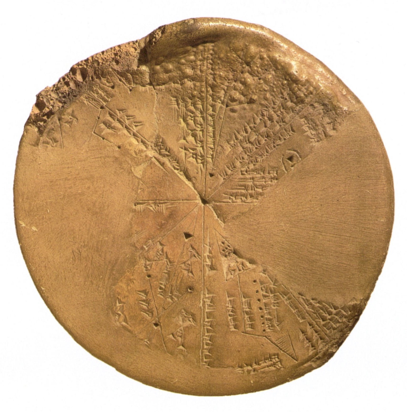
Assyrian star planisphere found in the library of the Assyrian king Ashurbanipal (Aššur-bāni-apli – reigned 668-627 BCE) at Nineveh. Kuyunjik Collection, British Museum, K 8538 [= CT 33, 10]. London.
The function of this unique 13-cm diameter clay tablet, in which the principal constellations are positioned in eight sectors, is disputed, but the legible constellations can be used to re-create the star map it originally displayed in text.
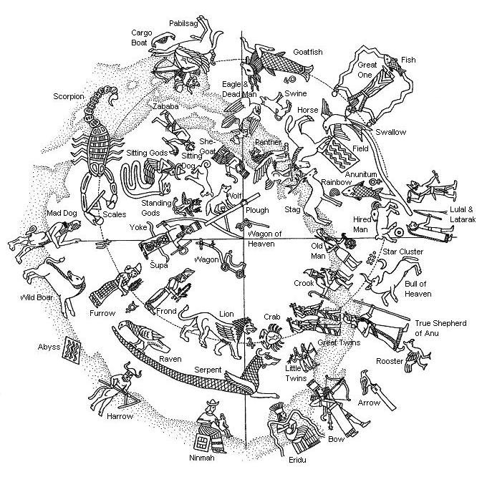
The reconstructed artistic rendering illustrated depicts drawings rather than the text itself. Drawings of Babylonian constellations also appear on tablets:
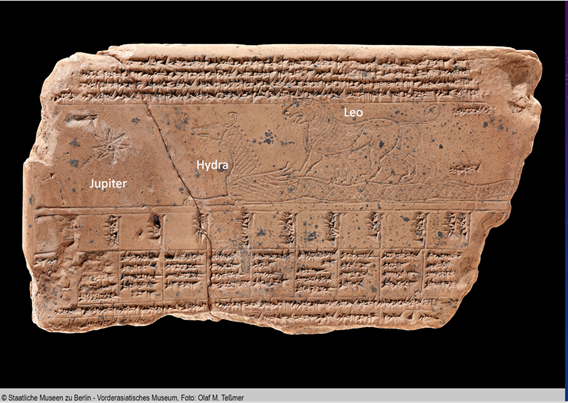
Calendar text for the zodiacal sign Leo, Uruk (Warka), Seleucid period, ca. 200 BCE, recto/fragment, Vorderasiatisches Museum, Berlin (VAT 7847).
These tablets show how mathematically regular and precise diagrams were being produced even in the Hellenistic age, though they may not have all survived on papyrus. People were visualizing and producing tactile diagrams of the heavens long before the medieval age.
Melothesia: The Anthropomorphic Cosmos in Rome and India
by Tejas S. Aralere
I’ll build briefly here on the preceding discussion of the zodiac by discussing the origins of melothesia – the pre-Ptolemaic astrological theory that placed (thesis) the 12 zodiac signs on different limbs (melos). I will then discuss the anthropomorphic theories of cosmic structure in Imperial Latin poetry and bridge this discussion to that of Jyotiṣa or Jyotiḥ Śāstra, Sanskrit for the “Science of Heavenly Lights” to demonstrate one way that astrological theories circulated between the Mediterranean and India in antiquity beyond translation of whole books.
Above, Rebecka briefly mentioned melothesia, referring to the systematic arrangement of the zodiac signs on the human body. While this became part of medieval medical theory and the cornerstone of bloodletting practices, the origins of the melothesia date much further back. The idea also had wide circulation, with it likely originating in the Mediterranean, moving through India, then through Arabic sources, and making its way back into the European traditions. The first instance of zodiacal melothesia in the Classical tradition appears in Manilius’ Astronomica, and was originally written off as superfluous to the rest of the text’s content, since melothesia alone does not aid the reader in calculating auspicious astrological times. But if we read the two passages in which the melothesia appears in the Astronomica, it is clear that Manilius had precise reasons for including it where he did and that it was not a later addition to the text.
The melothesia arrangement is identical in both Astronomica passages where it appears (Astr. 2.453-465 and 4.704-709) and we provide the text and translation of the first instance below (Astr. 2.453 – 465):
Accipe divisas hominis per sidera partes
singulaque imperiis propriis parentia membra,
in quis praecipuas toto de corpore vires 455
exercent. Aries caput est ante omnia princeps
sortitus censusque sui pulcherrima colla
Taurus, et in Geminis aequali bracchia sorte
scribuntur conexa umeris, pectusque locatum
sub Cancro est, laterum regnum scapulaeque Leonis, 460
Virginis in propriam descendunt ilia sortem.
Libra regit clunes, et Scorpios inguine gaudet,
Centauro femina accedunt, Capricornus utrisque
imperitat genibus, crurum fundentis Aquari
arbitrium est. Piscesque pedum sibi iura reposcunt. 465
Learn how the parts of the human body are divided
among the zodiac signs, and how the individual limbs
are subject to their own ruling powers, in which they
exercise their principal strengths over the entire body.
from the whole body, they exercise particular strengths
over the whole body. Aries is allotted the head, the
Princeps over all, And Taurus is assigned the most
beautiful neck for himself, And to Gemini are written
the arms equal in distribution and connected to the
shoulders, and the pectus (chest, heart, mind) is placed
under Cancer, the chest and shoulder blades and lower
back are under the rule of Leo, The region from the hips
to the groin comes down to the appropriate portion of Virgo,
Libra rules the buttocks, and Scorpio rejoices in the sexual
organ, The thighs agree to Sagittarius’ (rule), Capricorn rules
both knees, The shin is governed by the flowing Aquarius.
The Fish (i.e., Pisces) demand the feet under their command.
This exposition of the melothesia comes after a technical discussion of the specific qualities of each zodiac sign and astrological aspects, or geometrical relationships, between the signs. By adding the human form to this geometric catalog, Manilius presents anthropomorphic geometry as yet another perfected method of analyzing astronomical and astrological alignments. The second instance of melothesia in the Astronomica appears in book 4, where Manilius tells us that the Zodiac governs different nations in the same way it governs the body (Astr. 4.696-710):
Hos erit in fines orbis pontusque vocandus.
quem deus in partes et singula dividit astra
ac sua cuique dedit tutelae regna per orbem
et proprias gentes atque urbes addidit altas,
in quibus assererent praestantis sidera vires. 700
ac, velut humana est signis discripta figura,
et, quamquam communis eat tutela per omne
corpus, et in proprium divisis artubus exit
(namque Aries capiti, Taurus cervicibus haeret…
It will exist in the boundaries of the world and
must be called the Sea,which the god (deus)
divided among the signs, each with its own
portion, and to each (i.e. sign) he gave its own
guardianship throughout the world and also
gave suitable races (of men) and lofty cities,
In which the signs claim outstanding powers.
And just as the human figure is distributed
among the signs, Although the protection
goes through the whole body, and Goes
out to the apportioned limbs – For Aries
clings to the head, Taurus to the neck…
The passage concludes with Pisces ruling the feet and we are told that the Zodiac signs influence different nations just like they influence the individual human limbs. Manilius often refers to the entire cosmos as a “corpus” really driving home the anthropomorphism of the cosmos (Astr. 1.134, 1.148, 1.810). Manilius claims that the physical qualities of various ethnic groups are related directly to the Zodiacal sign that rules over their region (Astr. 4.711-714):
Idcirco in varias leges variasque figuras
dispositum genus est hominum, proprioque colore
formantur gentes, sociataque iura per artus
materiamque parem privato foedere signant,
For this reason the human species is
distributed with different laws and
with different appearances, the races
(of men) are formed with their particular
skin color, and [the signs] imprint their
associated laws on their limbs and
imprint similar material with their own bonds.
Manilius draws on earlier Hippocratic tradition by connecting astrology with the theory of environmental determinism, which argues that the climate that a person is born into influences their psychophysiology, and provides exempla from each geographical region. To make sense of this, one can think of humans like plants being nourished from the ground up by the soil and water in the region they dwell, and equally influenced by the aporrhoia (effluent rays) emanating from zodiac signs and planets above. He follows this with a topothesia, connecting zodiacal influences with specific provinces within the Roman Empire:
| Zodiac Sign | Body parts | Geographical regions (4.744-817) |
| Aries | Head | Hellespont, Propontis, Syrians, Persia |
| Taurus | Neck | Scythian Mtns., Asia Minor, Arabia |
| Gemini | Arms to shoulders | Euxine Sea, Traces, Ganges |
| Cancer | Breast | Ethiopians |
| Leo | Sides and shoulder-blades | Phrygia, Cappadocians, Armenia, Bithynia, Macedonia |
| Virgo | Belly | Rhodes, Ionian Cities (Attica /Asia Minor coastal islands), Dorian fields, Arcadians, Caria |
| Libra | Loins | Italy |
| Scorpio | Groin | Carthage, Libya, Hammonia, Cyrene, Sardinia |
| Sagittarius | Thighs | Knossos, Minos, |
| Capricorn | Knees | Spain, Gaul, Germany |
| Aquarius | Shanks | Egypt, Walls of Tyre, Cilicia, Plains of Caria |
| Pisces | Feet | Euphrates, Tigris, Red Sea, Parthia, Bactria, Asiatic Ethiopians, Babylon, Susa, Nineveh |
While the logic behind some of these correlations is unclear, note that Italy alone is ruled by Libra. Given that he is composing his work at the beginning of the Empire, Manilius makes the most of Libra’s scales imagery, saying that Italy alone, positioned at the center of the body, embodies justice throughout the empire. Congruously with this idea, we should also remember that Augustus published his horoscope and emblazoned his birth sign Capricorn all over coinage and monuments, granting astrology the status of a state-sanctioned divinatory method throughout the empire. We see here how the anthropomorphic map might translate to and from a medical theory, where illness arising in one “body part” could trigger further illnesses elsewhere in the body. There is much more to say about this, but I hope this makes clear at least some of the ways in which astrology and melothesia in particular were central to imperial and colonial ideologies of the Augustan Age. No drawings of melothesia survive from antiquity, but the simplicity of this theory, and its adaptability to nearly any other culture’s astrological framework makes it quite possible that it spread either just as a standalone idea or as part of a textual tradition traveling with an astrologer or scholar. But the exquisite Les Très Riches Heures du Duc de Berry of which one folio is included above, includes one of the most famous illuminations depicting the melothesia:

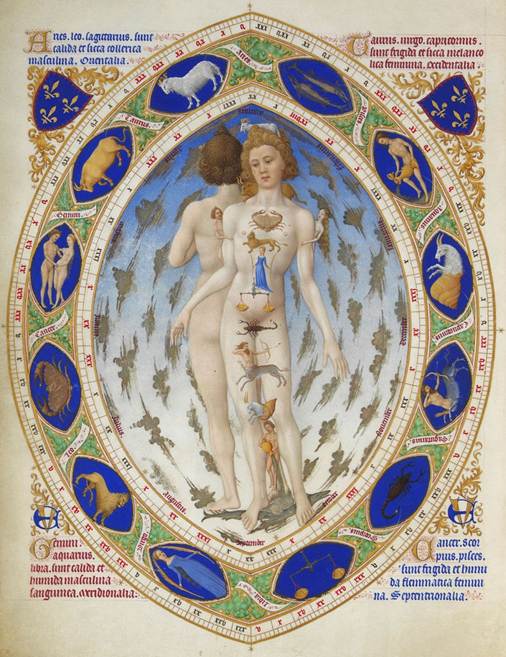
We see the zodiac twice here, both mapped on the body parts that they govern, and surrounding the man, corresponding with each of the months they govern written in red closest to the figure of the man. Moving from the center outward, the first set of measured lines demarcate the 30 days of each month, and the outermost ring demarcates each of the 30 degrees that the 12 zodiac signs span. The corners explain which cardinal directions govern specific zodiac signs and their Hippocratic medical properties.
Recently, in 2015, a cuneiform tablet was retranslated by John Wee (2015) show this same melothesia arrangement. Though the date is not definitively ascertainable, it likely pre-dates Manilius’ text given the earlier Babylonian textual tradition that track astrological associations between stars, plants and the human body. Considering that cuneiform writing was being phased out by the first century CE, but still being read by scholars, this tablet could post-date the material in Manilius – we just don’t know.
Kāla Puruṣa: The Indian Time Man
What makes melothesia even more interesting is that it appears in Sanskrit astrological treatises just two centuries later, in a text called the Yavana Jātaka, translated as the Ionian Horoscopy. The treatise is said to have been composed by an otherwise unknown poet known as Sphujidhvaja, and was composed as part of an earlier tradition of jyotiṣa, or Indian astral sciences.
A codified astral science tradition tradition seemed to have developed by 1200 BCE, with the composition of the Vedāṅga Jyotiṣa (VJ) or the “Ancillary Limb of the Vedas dealing with Heavenly Lights.” For the priestly-scholar class of Brahmins who officiated the yajña fire sacrifices, tracking time was of utmost importance for developing and adhering to the ritual calendar. During these complex rituals, Brahmins chanted the Vedas, Sanskrit hymns about various deities composed and transmitted through oral tradition through a hereditary male line from around 1500 BCE to the modern day. The YJ was composed soon after the Vedic hymn corpus was codified, a process that is thought to have finished by 1200 BCE. Originally composed and transmitted through oral tradition – the standard practice for Brahmanical knowledge – this treatise lists the 27 nakṣatra constellations with their presiding deities, and discusses the motion of the Sun and Moon against the belt of asterisms, and teaches the method of calculating various periods of time; this covers primarily what we’d consider mathematical astronomy rather than the predictive or more interpretative astrology.
One note, before we go on: the language Brahmins used (and continue using today) for their rituals was Sanskrit, a descendant of the Indo-European linguistic family which also produced Greek, Latin, and all modern romance languages. Sanskrit was also the academic and intellectual lingua franca, the way Greek and Latin were at various times, for religious, scientific, and all other technical subjects. There is much modern debate over whether Sanskrit was also spoken by these communities or only used in the ancient equivalent of academic composition, but from the 5th century BCE, we see evidence for Prākṛt vernacular languages emerging, which were also being spoken and written, one of which was Pāḷi, the sacred language of Buddhist teachings and scriptures alongside Sanskrit – but I digress.
The astral system Brahmins devised tracked the motion of the moon against a belt of 27 constellations (sometimes 28) called nakṣatras. Initially, they only tracked the position of the Moon and Sun through these, some of which were considered more auspicious than others, and so choosing a beneficial moment was of utmost importance. While I will not present a comprehensive survey of the history of Indian astral sciences here, I’ll touch on one of the most important periods in which this indigenous Sanskrit astral science connected with the Hellenistic astral sciences described above by Rebecka, between the 1st century BCE and the 2nd century CE. The specifics of exactly how this exchange occurred do not survive through the textual record, but two interesting Sanskrit texts present us with instances possibly explaining how the astrological concept of the zodiac made its way from Mediterranean sources into the Indian texts. The Yavana Jātaka (YJ) or the “Ionian Horoscopy” (from the Persian transliteration of the Greek Ιωνία), is a text that survives mostly intact along with a possibly older Vṛddha Yavana Jātaka. I will focus here on the YJ because its opening verses present us with the melothesia, the arrangement of the 12 zodiac signs mentioned above.
There are two sections of the YJ that are of interest to this current discussion and they are the opening verses of the Yavana Jātaka which present the melothesia and the final chapter 79 which contains transliterations and translations of Greek technical astral scientific terminologies into Sanskrit. What makes the YJ’s opening verses particularly interesting is that they contain the same melothesia that appears in Manilius’ Astronomica composed between 20-40 CE in Rome. We will come to that text in a bit. First, here are the opening verses of the YJ (1.14-17):
The first (sign) is traditionally said to have the shape of a ram; it is called by the ancients the head of Kāla. Its places are the paths of goats and sheep, caves, mountains, (hideouts of) thieves, and (places where there are) fire, metals, mines, and jewels. (1.14)
The second is said to have the shape of a bull; it is the mouth and throat of the Creator. Its places are those of forests, mountains, ridges, elephants, herds of cows, and farmers.
The third is a couple (a woman and a man) holding a lyre and a club (respectively); it is the region of the shoulders and arms of Prajāpati. Its places are those of dancers, singers, artisans, and women, and (places for) playing games, sexual intercourse, gambling, and recreation.
The fourth, which has the form of a crab standing in water and which is the region of the chest, is called Karki (Karkinos). To it belong meadows, wells, and sandy beaches, and its places are the pleasant playgrounds of goddesses.
This list continues on down to Pisces which are said to govern the feet. The signs here are mapped onto the body of Kāla Prajāpati, the anthropomorphic manifestation of Time and an incarnation of Prajāpati, the Vedic creator god. Various elements, places and occupations associated with each sign are also given. Note that there are few specifics on geographic locations given here–no specific cities are named. This is also one of the earliest known instances of the 12-sign Greco-Babylonian zodiac appearing in Sanskrit sources, so while this proves that there certainly was an adoption of zodiacal astrology from the Mediterranean likely through Northwestern India, where the Hellenistic and Indo-Greek kings had long interacted with one another, it does not prove that all astrology in the Indian subcontinent was of Mediterranean origin. The YJ’s author is careful to contextualize the zodiac within the framework of much earlier Brahmanical material, indicating the conservative attitude of the Brahmanical intellectuals in this period. Even the title of the text as the “Yavana Jātaka” indicates the foreignness of this particular astrological method as one outside the traditional Brahmanical fold, mirroring the Greco-Roman labeling of astrology as Chaldean or even Indian.
The final chapter of the YJ contains transliterations of terms with Greek origins, such as horā from the Greek ὥρα, kendra from the Greek κέντρον, and drekkāṇa from the Greek δεκανός. While earlier scholarship took this as evidence for the translation of whole Greek treatises into Sanskrit (akin to the Greco-Arabic translation movement) this seems unlikely given the extensive contextualization for the Indian religio-political context that the text undertakes.
The idea of an anthropomorphic organization of the cosmos, however, was an idea that had developed by the Vedic period (1500-1200 BCE) in India. In the 9th century BCE Śatapatha Brāḥmaṇa ( where the five layers of the brick fire ritual altar are correlated with the different regions of the cosmos and the parts of the human body (hair, skin, bones, flesh, and marrow).
In the famous Bhagavad Gīta (“The Divine Song”) where the god Krishna reveals his Viśva Rūpa, or his “All-Pervading Cosmic Form” illustrated below:
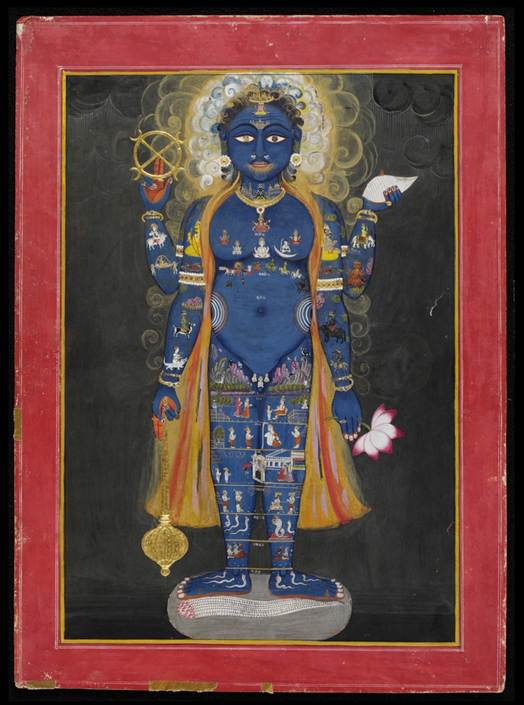
Victoria and Albert Museum: IS.33-2006

This painting was made in Rajasthan, India, around 1820 and is currently in the Victoria and Albert Museum’s collection. I include this image because it serves as one example of a correlated depiction of the human body’s connection to the cosmic entities, but does so in a markedly different way from the Medieval European and zodiacal examples we’ve examined. This manuscript illumination serves as a reminder that all life, except Viṣnu’s (God of Cosmic Preservation) own, is impermanent and transient, brought into being by Brahma, the Creator god whom we see at the top of his head, and Śiva the god of cosmic destruction, who is depicted on his chest, seated next to the crescent Moon. Sanskrit sources variously connect the Vedic creator god Prajāpati’s different incarnations, like Kāla mentioned above, with Viṣnu and Śiva.
In this body-cosmos map, we, the earthbound viewers, are situated at Kāla’s bellybutton. This is the realm of human existence, and is just one of 14 lokas (universes) said to exist within the Hindu and Buddhist Cosmologies. Starting from Bhu Loka, there are six more upper lokas and seven lower lokas. Each of these 14 universes contain their own planetary systems with various species of beings living in them, who, depending on their divine status, can travel between them.
If we imagine ourselves standing in between the rainbows on his belly and looking upwards from his navel, we come to Bhuvar Loka which is his midriff. You see a parade of seven figures of different colors parading across his body with Surya the Sun god on his chariot with seven white steeds, leading them at the far left, followed by the Moon, Mars, Mercury, Jupiter, Venus, and with the least auspicious planetary god, Saturn on his black ox, bringing up the rear. Below the Sun we see a separated head and body, representing Rahu and Ketu, the lunar nodes. Together they comprise the Nava Grahas, or the Nine Planets discussed in the Indian Astral sciences. Beyond lies Svar Loka, the universe of Indra, the king of the gods and rain. On Kāla’s chest, between the Svar Loka and Mahar Loka, we see dots representing the nakṣatras. Downwards from his navel, we see the various lower universes, all the way down to the Pātāḷa Loka the realm of the Nāga snake beings. Note here that upper and lower universes do not correlate with Abrahamic conceptions of heaven and hell.
Astrological influence from planets on the body is so central to the Indic conception of the integrated interrelatedness of the terrestrial and celestial bodies that our painter depicts Viṣnu as being conscious of the planetary influences on his own body. On each of his four wrists, we see Nava Ratna bracelets with nine different colored gemstones representing these planets, balancing the effects of the Navagrahas. Not even Viṣnu, in whose body the planets, stars, and all creations exist, is immune to the powerful effects of the nakṣatras and grahas. The perspective on human connection to the cosmos is also strikingly different. The Brahmanical cosmos was itself an anthropomorphic entity which contrasts with the European interpretation which depicts man enclosed within series of concentric spheres that all affect and shape his body in varied ways.
Astrology the Oldest Science
As Rebecka mentions above, astrology has now been relegated to the back pages of newspapers and magazines as novelties, or new-age apps, but there’s nothing “new age” about astrology. It remains a current practice with various forms practiced around the world, that are constantly updated, in both their content and adaptation to our modern world. Once we move past pointing out the flaws in astrological theory – that it posits a geocentric cosmos and that gravitational forces from planets and stars don’t affect our lives – we can begin to see a much richer method of natural philosophy emerge. Astrology is the oldest science in the world that has been continuously practiced in its various forms from at least the 2nd millennium BCE to the modern day. Think of the kingdoms, religions, languages, and alternative scientific models that have risen and fallen, and challenged astrology’s authority; all of them and modern science ultimately failed to kill it off. This is remarkable!
Astrology presents us an intellectual and academic nexus to examine how early interdisciplinary inquiry into the natural world operated. It claims to show how celestial events affected the fates of humans, animals, and the entire planet through a combination of mathematically precise methods whose interpretative application to life affairs made it especially attractive as a way to analyze and understand cosmic causes and effects. This is still one of its draws today. Its ‘foreign science’ status as discussed above and its mathematical foundation makes it easily adaptable to whichever religio-cultural context it enters. It justified everything from theories of empire to medical diagnoses all through meticulous calculations and led people from multiple cultures to produce beautiful illustrations and artworks in an effort to visualize it in all its complexity. As we admire these images, we might also rethink how we critique the astral sciences. Ptolemy opens his Tetrabiblos in section 1.2 saying that we don’t blame the sciences (technai) of navigation or medicine if a sailors navigates off course or a doctor misdiagnoses an illness; the science is perfect, but the practitioners range in skill level. The same, he says, applies to astrology, and warns that:
ἀλλ̓ ὅμως ἐναργές ἐστιν ὅτι κἂν διερευνητικῶς τις ὡς ἔνι μάλιστα καὶ γνησίως τοῖς μαθήμασι προσέρχηται, πολλάκις πταίειν αὐτὸν ἐνδέχεται, δἰ οὐδὲν μὲν τῶν εἰρημένων, δἰ αὐτὴν δὲ τὴν τοῦ πράγματος φύσιν καὶ τὴν πρὸς τὸ μέγεθος τῆς ἐπαγγελίας ἀσθένειαν.
Nevertheless, it is clear that even if someone approaches these studies (i.e., Astrology) with the utmost inquiry and in the most genuine and legitimate spirit possible, he may often still err – not for any of the reasons mentioned earlier, but because of the very nature of the subject itself and because of his own weakness relative to the magnitude of the undertaking.
Given its importance throughout history and in modern times, perhaps skeptics should heed his warning today – perhaps they just haven’t found a skilled astrologer.
Wee, J. Z. (2015). Discovery of the Zodiac Man in Cuneiform. Journal of Cuneiform Studies, 67, 217–233.
Newly-Acquired Τreatises on Αstrology from the Middle Ages and the Renaissance in the CHS library
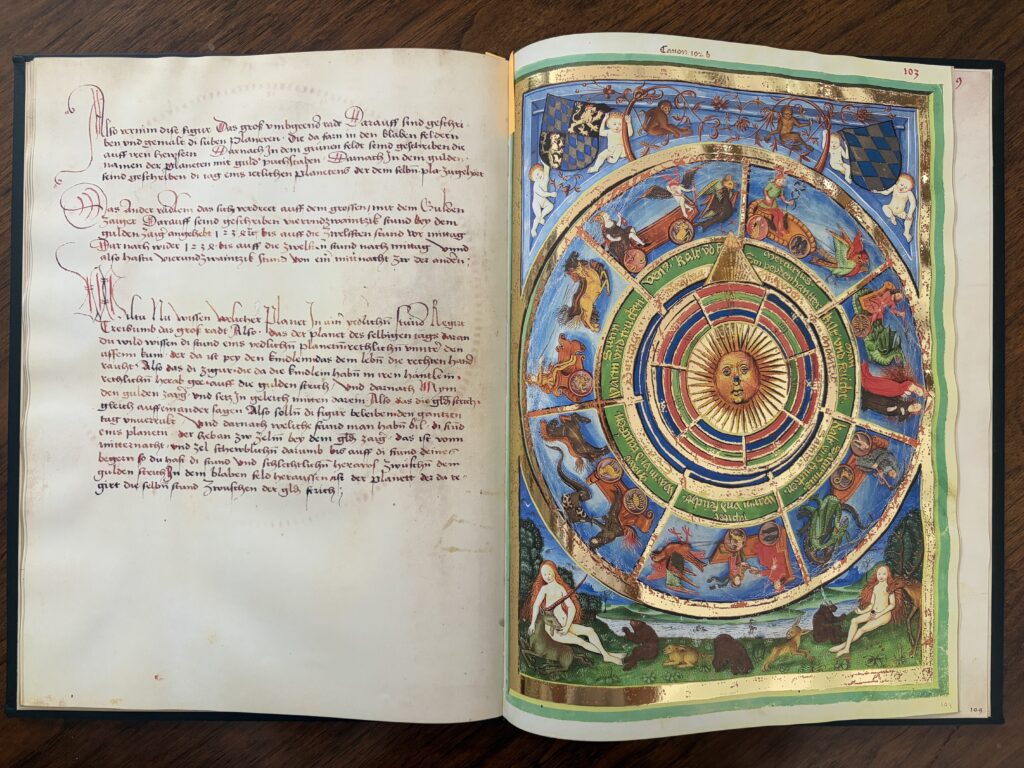
“Drehbare Sonnenhur mit Tierkreiszeichen (Rotating sundial with zodiac signs), ”Heidelberger Schicksalsbuch (1491) – Heidelberg, Universitätsbibliothek Heidelberg, Cod. Pal. Germ. 832. CHS facsimile.
First section describes and depicts star constellations beginning with the Big and Little Bears, followed by the Crown, Hercules, the Lyre, the Swan, etc. Then follow the signs of the Zodiac, after that the 7 planets (see below), then an astrolable with days, phases of the moon, the zodiac signs, with the sun and moon at the center, followed by medical conditions governed by the humors and planetary alignments, and the winds and the four elements.
Dr. Aralere points out that “the pointer arrow aligned with the top of the Sun’s head in the image above is part of a volvelle, a cut piece of highly illustrated parchment that can be rotated on a thread fastener fixed in its center (in this case on the Sun’s nose). In the image above, is the arrow pointing at the wedge governed by the planet Venus, the wheels of whose chariot depict the zodiac signs Taurus and Libra. Underneath Venus, “Freitag” is written since that is the day of the week she governs. The numbers on the smaller multicolored rings are numbered up to 24 to tell the reader which hour is governed by which planet on a specific day of the week. Knowing this would help determine the most auspicious hour of the day to undertake various activities.”
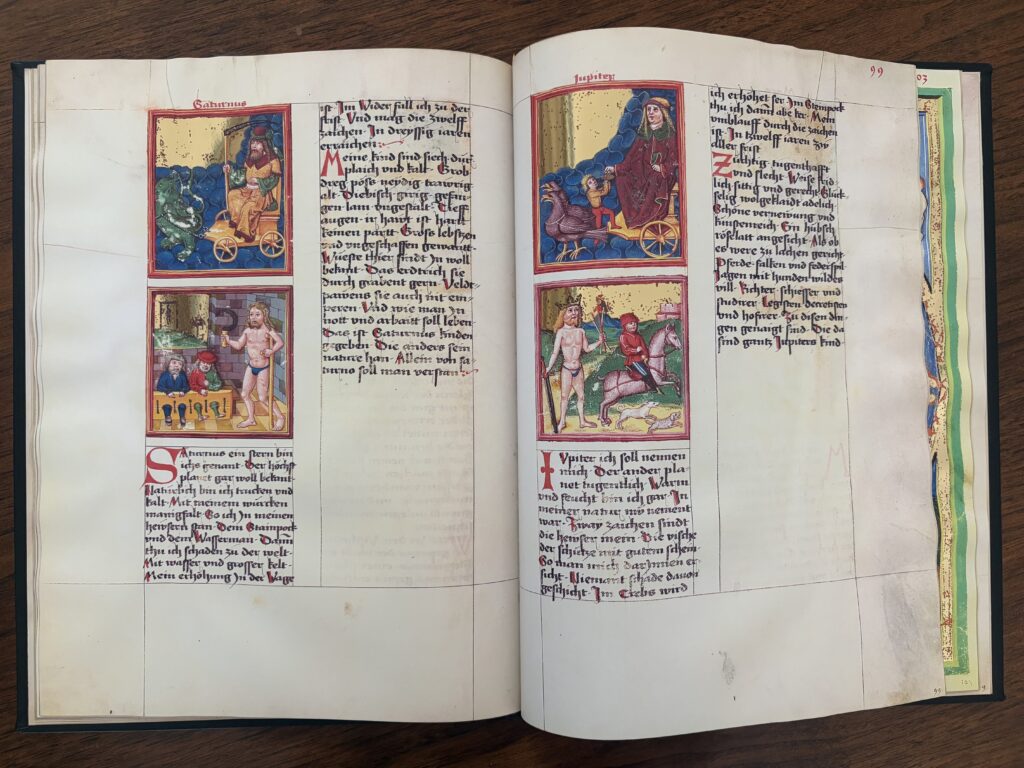
Texts and images of the presence and influence of the gods and the planets Saturn (left) and Jupiter (right) in people’s daily lives “on individuals born under their influences, called “natives” in astrological terms. The natives of Saturn bear a sickle since they toil away on the farm, limping with a crutch under one arm and trapped in the stocks since it is their lot in life to endure hardship. The natives of Jupiter on the other hand are more fortunate leading lives blessed with good fortune and a kingly status (since Jupiter was the king of the gods)” (Dr. Aralere).
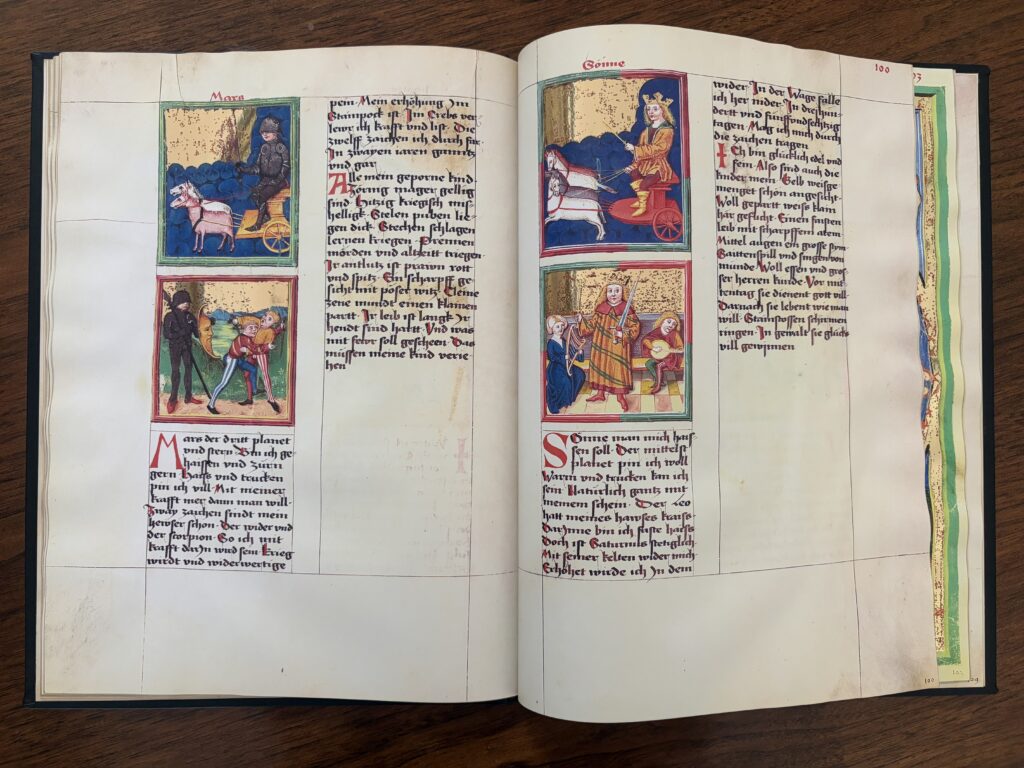
Mars (left) is depicted wearing a uniform as befits the god of war. The Sun (right) is depicted just as Jupiter with a staff and sword, and and “his natives is a healthy-looking kingly figure with a sword” (Dr. Aralere). He is accompanied by a female harpist and a male mandolin player in addition to his regular attributes of horses (3, not 7) traversing the heavens.
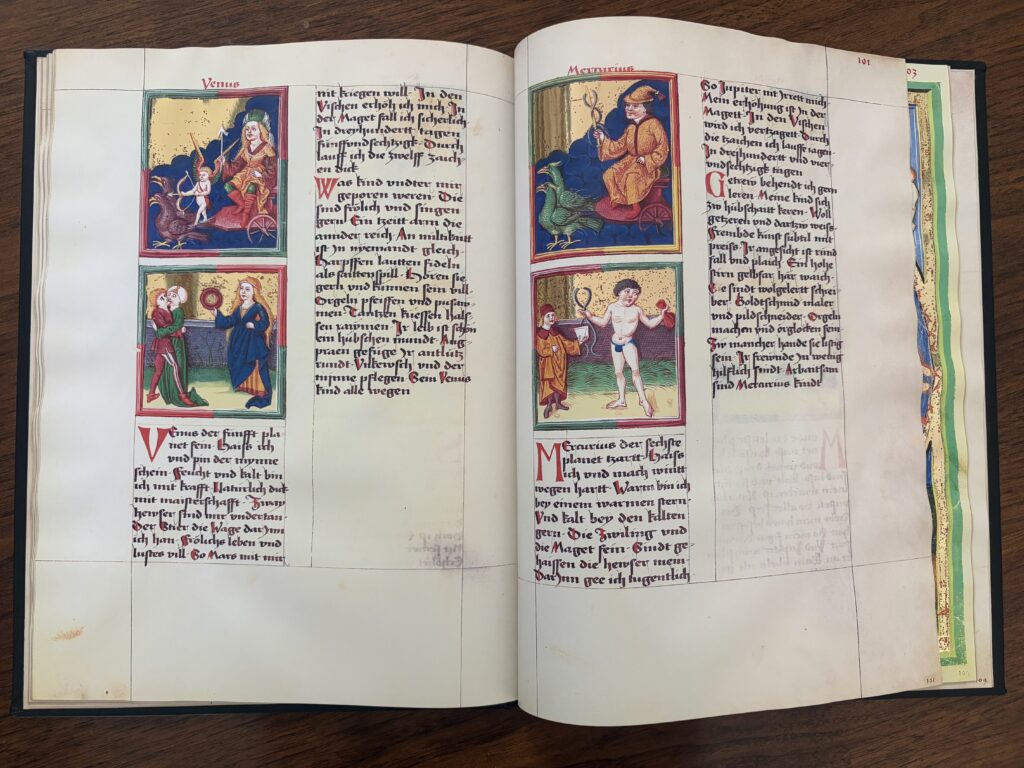
Unusually, Venus is represented with eagles, commonly the attribute of Jupiter, and Mercury, too, in addition to the caduceus and a money bag and measuring rod as befitting the god of commerce.
The Heidelberg Book of Fate (Heidelberger Schicksalsbuch or Astrolabium Planum of Heidelberg). Digital version. CHS facsimile.
A guide to celestial fortunes which was likely created for Philip, Elector Palatine of the Rhine, and his wife, Margaret of Bavaria, in 1491 or shortly thereafter. It contains astronomical reference guides and calendars for moon cycles over two nineteen-year periods, dates of solar and lunar eclipses, and times of sunrises and sunsets based on the latitude of Nuremberg. It is renowned for its two full-page images with movable pointers which indicate solar and lunar positions by Berthold Furtmeyr. The manuscript includes 542 additional illustrations by unidentified artists. In addition to a calendar and astronomical tables and texts, it also includes texts on the humors, elements, and winds, and prognostication tools. Especially noteworthy is the functional paper astrolabe on fol. 103 and into the back cover, treatises on the signs of the zodiac on fols. 92v-98r, on the four elements 106r-108r, and on dreams 110r-116r.
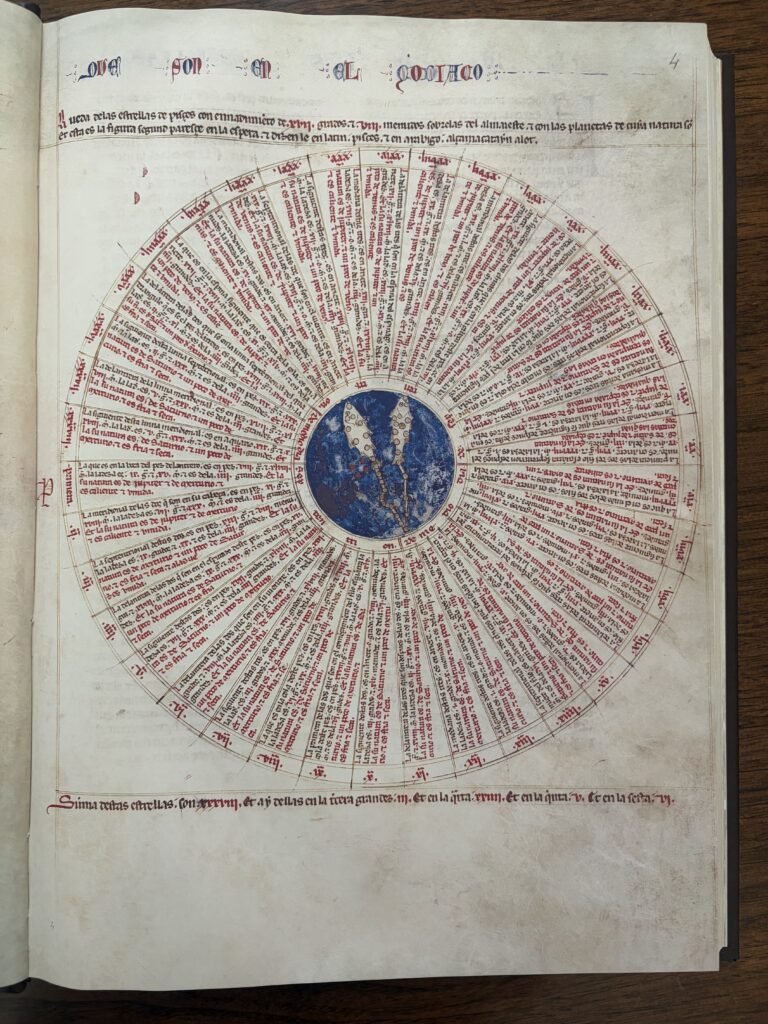
Of the forty-eight constellation wheels that made up the star books forming the first part of this compilation, the current codex preserves only eighteen. Most are mutilated in the central area where the constellation figure appeared; only those on folio 4 (Pisces) and a few others, which indicate the position of the stars on the astrolabe, remain intact. In Castilian, this figure, the last of the twelve signs, is called Pez; in Latin, it is called Pisces; and in Arabic, it has two names. Its proper name is Gehmeh Queteyn, though astrologers commonly refer to it as Alhut. This figure contains thirty-two stars within its outline and four outside it. The first of the inner stars lies in the mouth of the leading fish, known as Alhut Qanubi, meaning “the southern fish.” The second is the southern star located on its head, and the third is the northern star of that same pair, etc. (from Libros del saber de astronomía del Rey Alfonso X: Estudios y transcripción, Planeta De Agostini, 2004).
“Therefore, this sign is very auspicious and highly beneficial, especially because it is the house of Jupiter and the exaltation of Venus, two fortunate influences that naturally bring about all good things. Thus, anyone wishing to benefit from this sign should ensure that the ascendant is well-positioned.” CHS facsimile.
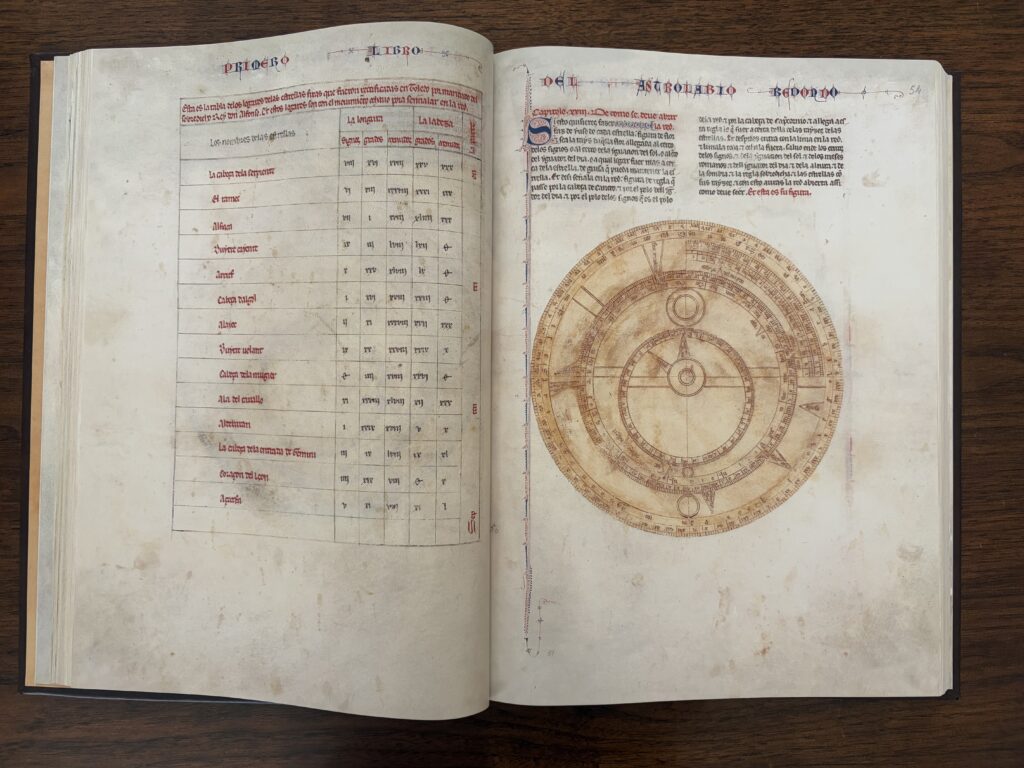
Table of the fixed stars over Toledo, Spain, in 1260 listing the names of the stars such as (the head of) the snake, (the head of) the woman, (the heart of) the lion, (the wing of) the horse, etc. The Babylonian zodiac also has horse, snake, and lion signs and 15 other animal signs. The Chinese horoscope has a snake and horse and 9 other animal signs. The Egyptians had 12 mostly animal-god signs, such as Bastet (cat goddess), Sekhmet (lion goddess), Thoth (ibis and baboon god), Anubis (canine god), etc. The table in the image indicates the positions in longitude and latitude of the northern stars. To the right is an astrolabe (ἀστρολάβος “star-taker”) which was a portable astronomical instrument to identify and locate stars and planets, calculate time, and determine local latitudes. It was used by both Hipparchus in the Hellenistic era and Ptolemy in the 2nd century CE (from Libros del saber de astronomía del Rey Alfonso X: Estudios y transcripción, Planeta De Agostini, 2004). CHS facsimile.
The work further includes instruction on how to construct different kinds of astrolabes, armillary spheres, quadrants, astronomical (water) clocks, planispheres, and reticles, and how to operate them. Also included are numerous astronomical charts and tables.
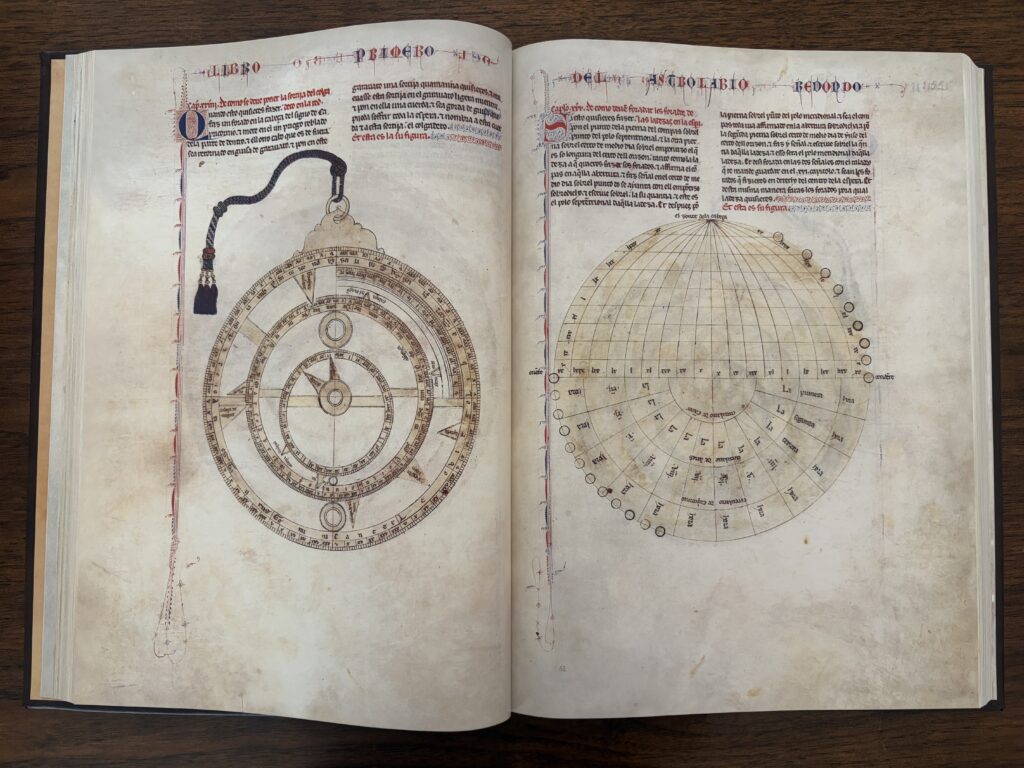
“Place the compass on the North Pole and the other on the meridian circle, specifically at the point corresponding to the horizon’s altitude for the latitude at which you wish to make the holes, and fix the compass at that opening. Then, mark the point on the meridian circle where it meets the aforementioned altitude line and label it with its value; this marks the North Pole for that latitude. Afterward, place the compass on the South Pole…” (instructions on how to use an astrolabe).
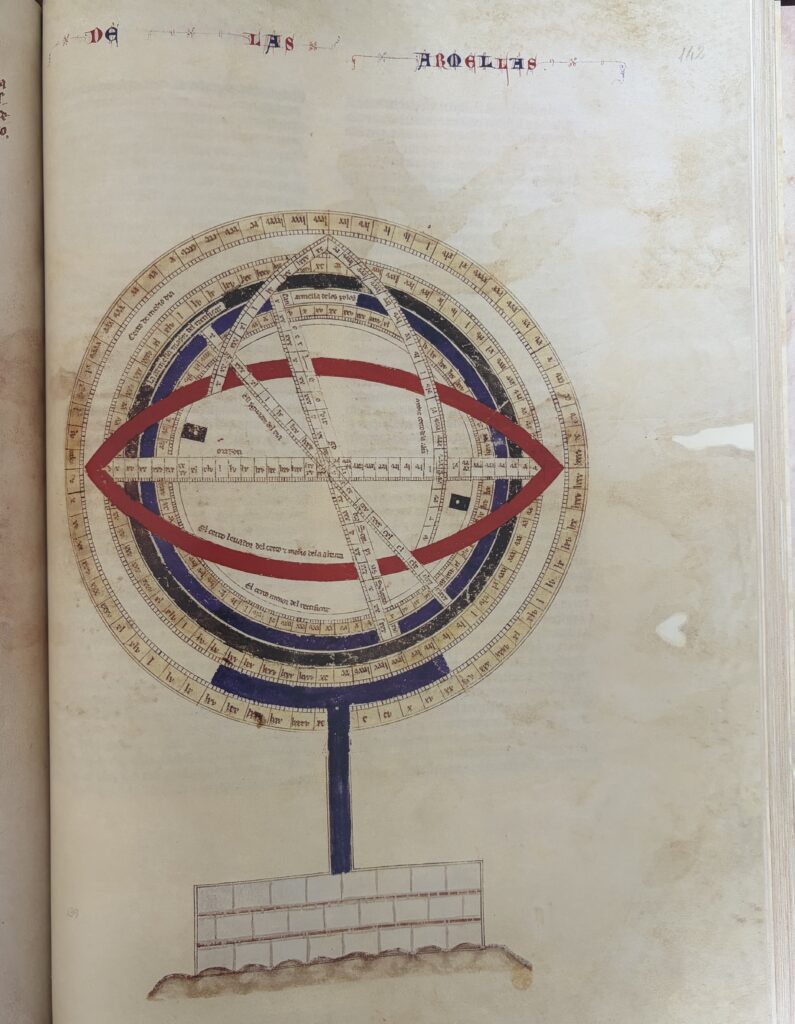
An armillary sphere, a model of objects in the sky consisting of a series of rings centered on the earth (Ptolemaic) or sun (Copernican) representing lines of longitude and latitude and the ecliptic.
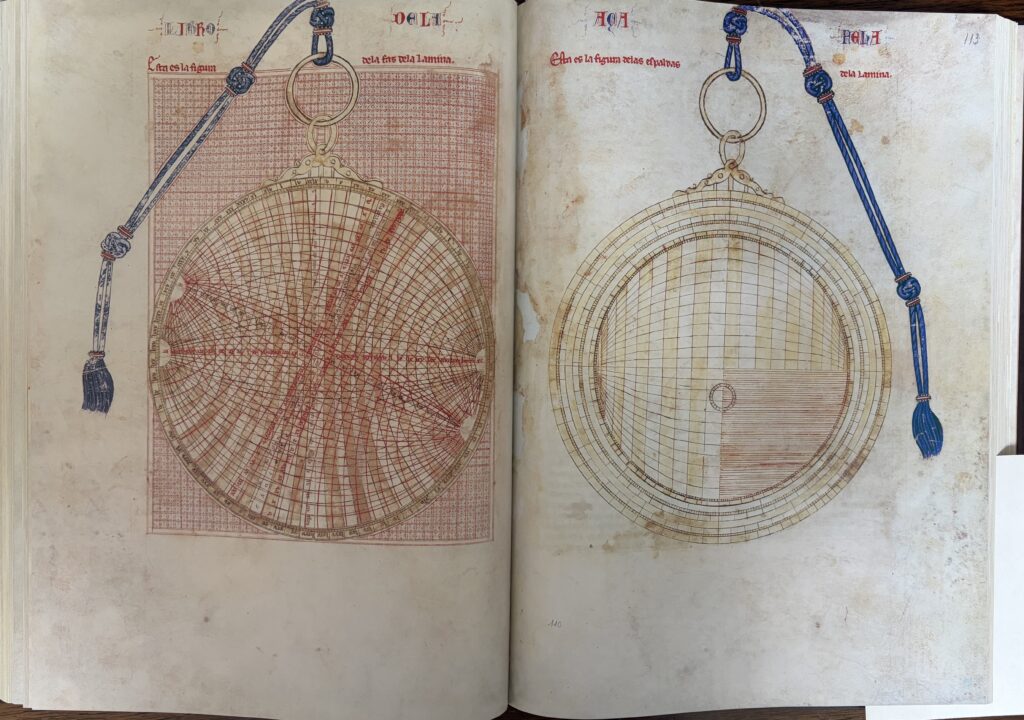
A fully constructed astrolabe.
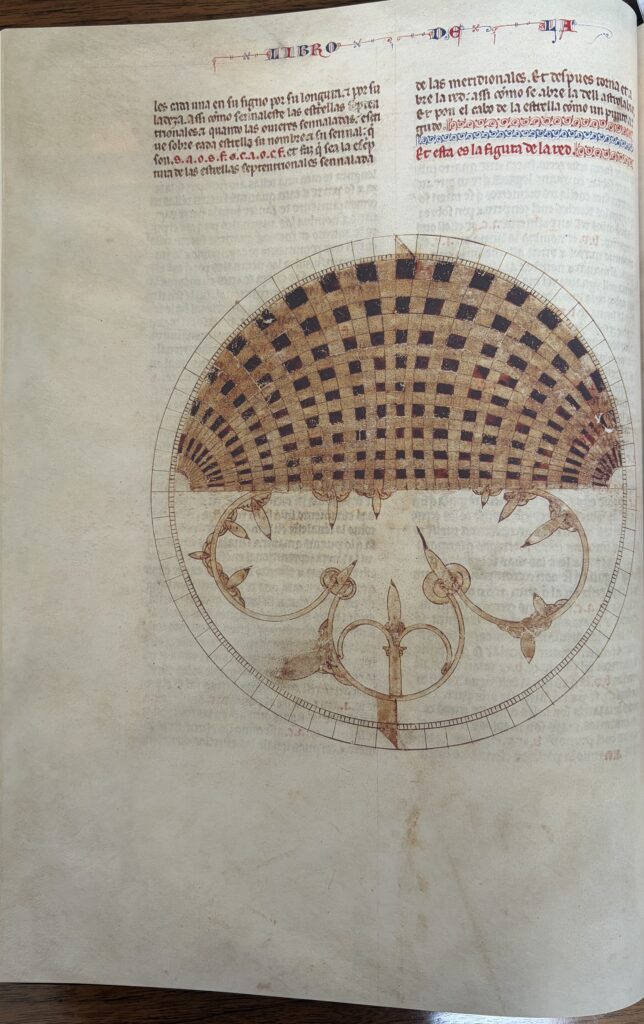
A rotating, metal grid with pointers overlaying an astrolabe, a so called rete (net) or reticle.
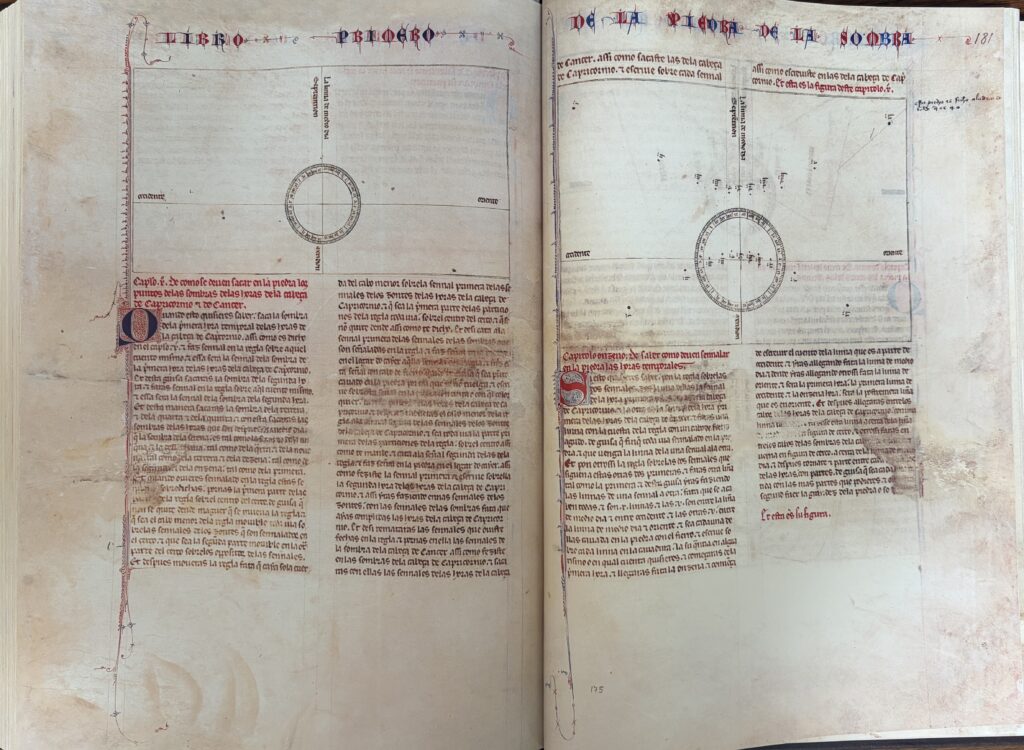
Dr. Aralere describes these figures as “a map of the horizon that is made into a horizontal sundial that could be carved on a stone slab and be placed flat on the ground by calibrating it to the location’s latitude. A gnomon (short stick) would be affixed to its middle. The changing length of the stick’s shadow throughout the day would tell the hour of the day. This manuscript provides multiple types of patterns for making these shadow clocks.”
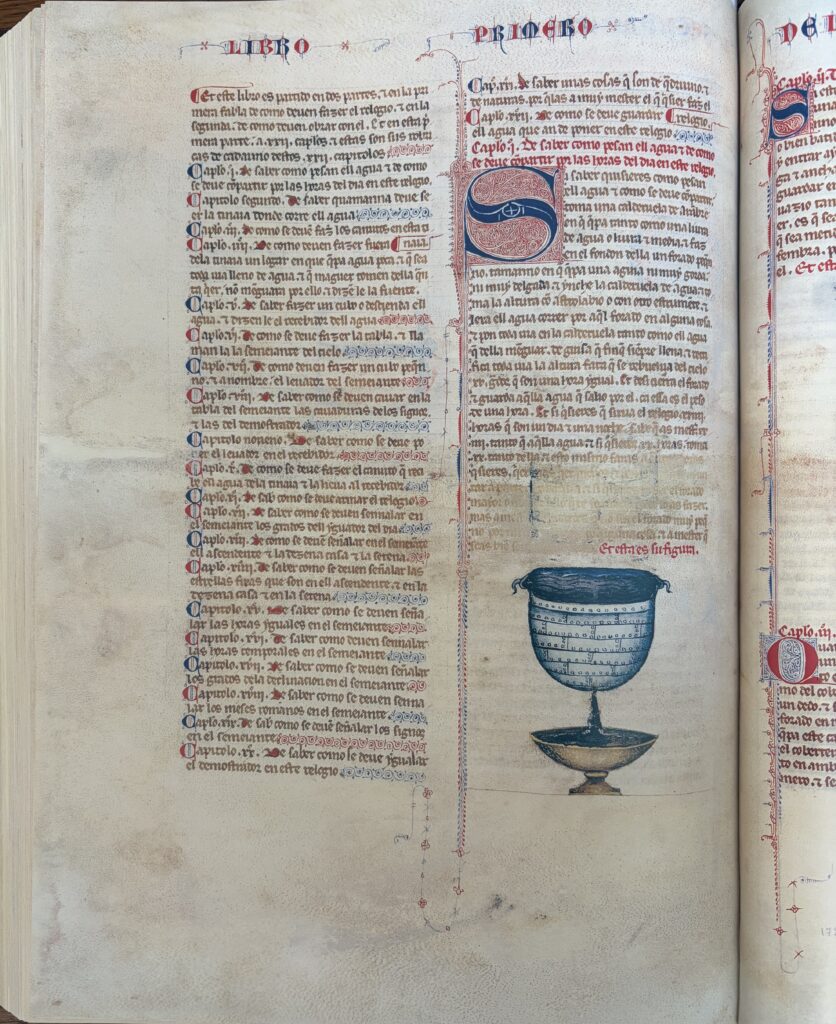
A water clock uses the flow of water to measure time. Called a klepsydra “water catcher” in Greek, there are known examples from Babylon and Egypt from as early as ca. 1600 BCE.
Dr. Aralere writes, “a hydraulic klepsydra was even built in the center of the Athenian Agora making it visible to the public although the details of exactly how it worked are still not fully understood.”
Manuscript MS 156, known as Libro del saber de astrología, contains a compilation of sixteen medieval astronomical texts. The codex comprises 201 parchment folios (42 x 30 cm) and it is written in Gothic script in brown ink and with red and blue initials and filigree decorations. It is structured in two columns with red rubrics and illuminations. The 162 illuminations include initial letters, marginal orles, line ends, illustrative panels, and didactic figures. It was commissioned by King Alfonso X and it is written in medieval Castilian. The texts are translations from Aramaic and Arabic by Jehudá ha-Cohen, Abraham de Burgos, Rabiçag de Toledo, and other Jewish, Christian, Muslim, Spanish, and Italian physicians and legal and ecclesiastic scholars, always with the King’s direct involvement to ensure more refined Castilian phrasing. The work covers three major thematic areas: astronomy (in the first treatise, which describes the celestial spheres and the signs of the zodiac, constellation by constellation); the use and construction of various astronomical observation instruments (treatises II through X, as well as the final one); and timekeeping devices, described in treatises XI through XV. There is also a catalog of 1,020 stars with their celestial coordinates. Clues within the codex point to Toledo, Burgos, and Seville as possible locations where the text was written, although most experts maintain that between 1276 and 1279 the Alfonsine scriptorium was based in Seville.
Originally from the library of Queen Isabella the Catholic and later sold to Cardinal Cisneros by King Ferdinand, the codex was included in the founding collection of the Complutense University Library. Nine later manuscript copies of the original exist. It includes also other works such as “Libro de la ochava esfera” and “Libro de la espera.” For more information, see. CHS facsimile.
This collection of famous astrological illustrations and texts includes the following works:
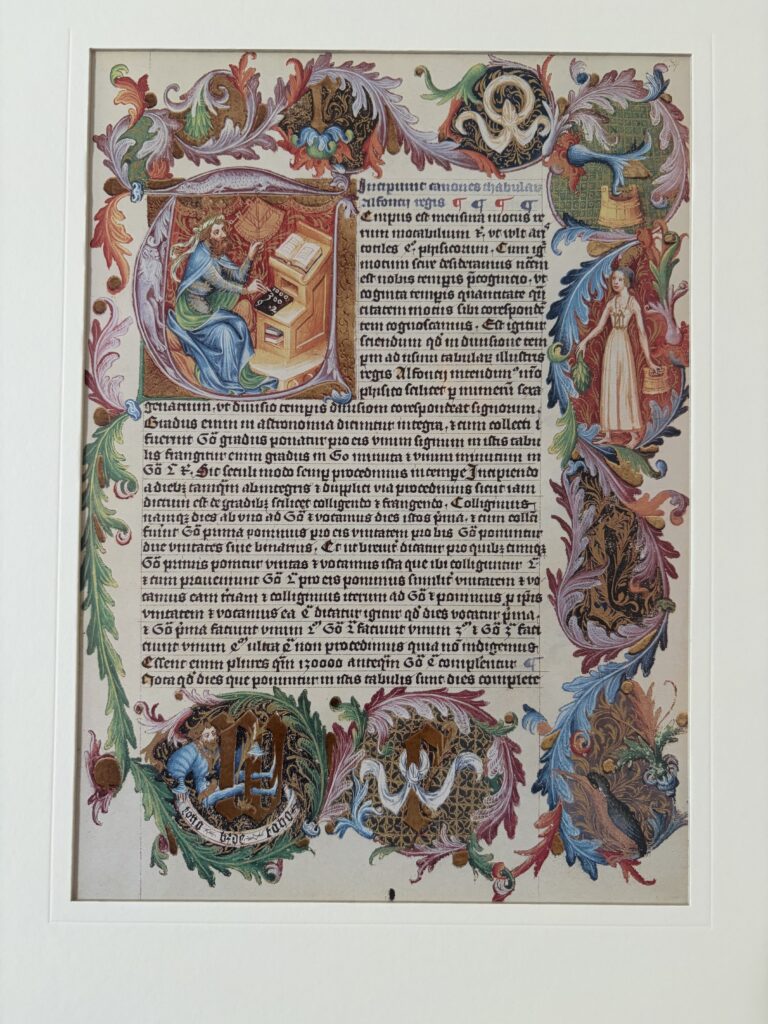
“Die Alfonsinischen Tafeln, ”Astronomische Sammelhandschrift König Wenzels IV (Prague, 1392-93) – Vienna, Österreichische Nationalbibliothek. Digital version. Leaf, CHS facsimile.
Illuminations of a lion and a snake framed by acanthus leaf tendrils along with a “love knot” and a kingfisher. The love knot is depicted as a white or blue ribbon tied into a bow with two fluttering ends. The final pages of the Vienna manuscript gather various types of prophecies and short treatises on demons. Among them is the Book of Prophecies of King Solomon, which originated in the mid-12th century and drew upon Arabic royal prophecies (from Von den Gestirnen: Meisterwerke zur mittelalterichen Sternenwelt, Coron, 2022).
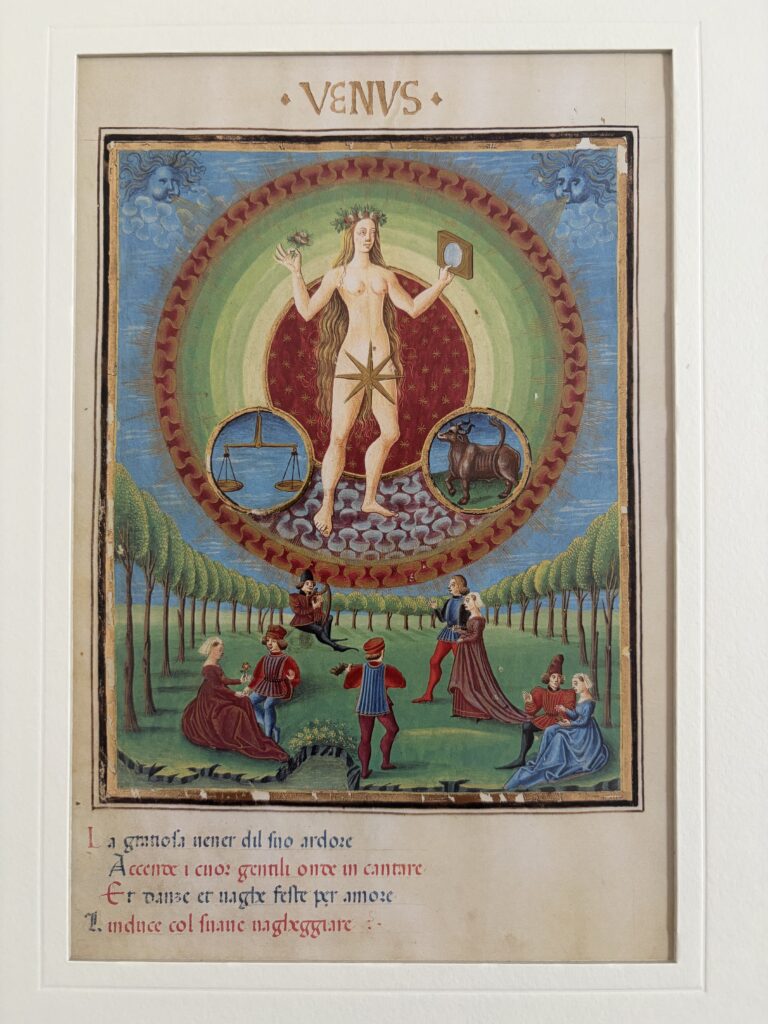
“Venere con i segni zodiacali della Bilancia e del Toro” (Venus with the zodiac signs Libra and Taurus), De Sphaera (mundi) (pseudo-Proclus) (1450-70) – Modena, Biblioteca Estense Universitaria, α.X.2.14 = Lat. 209. Leaf, CHS facsimile.
This is one of the most beautifully illustrated astrological treatises of the Renaissance. It was produced by Cristoforo de Predis in the workshop of Leonardo Da Vinci, see. It consists of 16 folios with 15 full-page miniatures and 9 astrological drawings. Francesco Sforza and Bianca Maria Visconti commissioned the manuscript. The 16-page book contains images with astrological and cosmological drawings and full-page miniatures of the planets. The planetary gods dominate the center of the image. They are surrounded by the zodiac signs and objects attributed to them. In the lower part of the miniature, their activity on earth is depicted. A four-line poem in blue and red ink describes the planet’s significance for humankind. In Venus’ left hand she holds a mirror, in her right a small bouquet of flowers. The same red and white flowers adorn her head. A star-studded, amaranth-red background, surrounded by a golden circle, transitions in concentric dark rings into a wreath with a ribbon-like, ruffled motif. The same motif is repeated in the ground on which the goddess stands. By her feet, the zodiac signs Libra and Taurus are depicted in a golden ring to the left and right. The entire sphere of the goddess hovers before a cloudy sky, in whose upper corners two cherub-like faces with golden hair are blowing winds across the scene. Below, on the ground, the scene described in the verses is depicted visually. Against a backdrop of blossoming poplars, there are three couples. Two musicians accompany the couples with a harp and a mandolin (from Von den Gestirnen: Meisterwerke zur mittelalterichen Sternenwelt, Coron, 2022).
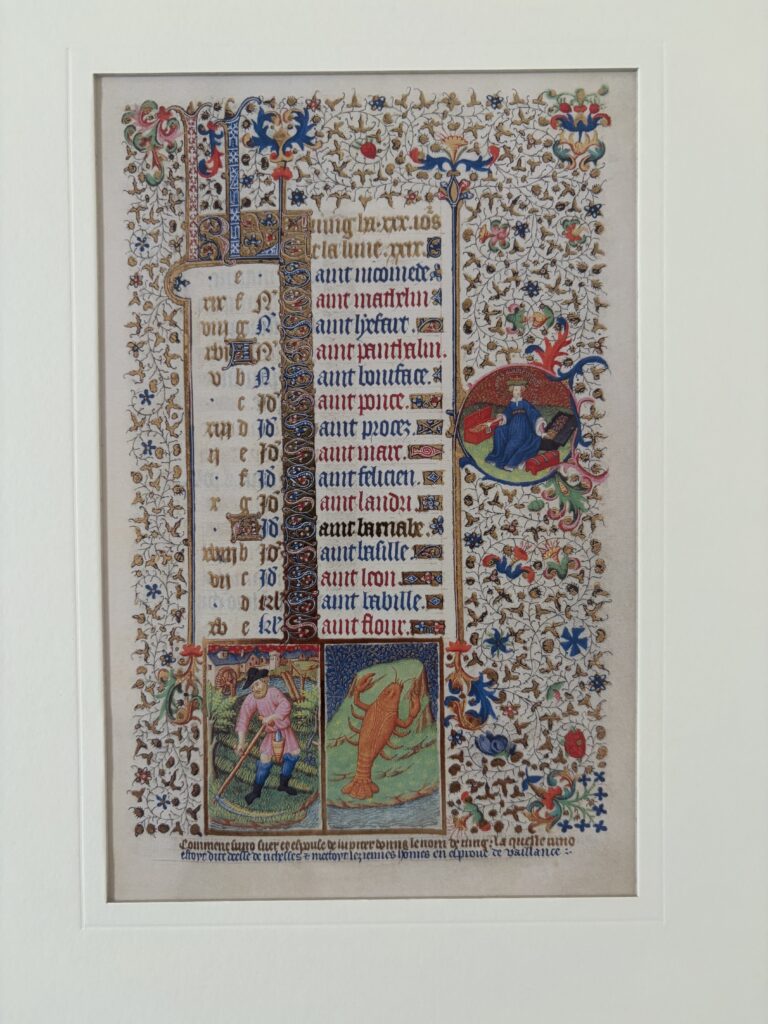
“Juin, avec le signe du zodiaque Cancer” (June, with the zodiac sign Cancer), The Bedford Hours – London, British Library, Add. Ms. 18850 (1420). For additional images, see. Leaf, CHS facsimile.
A French Book of Hours. Contains 38 full-page miniatures and more than 1,250 marginalia, see. It was commissioned by John of Lancaster, 1st Duke of Bedford, and his wife Anne of Burgundy. A farmer, dressed in a short tunic and boots, mows with the sweep of his scythe. In the background, a large waterwheel turns in the river; this, too, can be interpreted as a symbol of rural labor. Beyond it, the façades of a small town are visible. The image on the right depicts the zodiac sign for June, Cancer. The crab or crayfish occupies the entire area of the space. To the right, the goddess Juno, who gave the month its name, is seated. She is also referred to in the two lines of text in gold and blue at the bottom margin. Above the calendar, the letters KL are written in large letters, the abbreviation for the Latin word “Kalendae.” At Venus’ feet, to the left and right within a gold ring, the zodiac signs of Libra and Taurus are depicted (from Von den Gestirnen: Meisterwerke zur mittelalterichen Sternenwelt, Coron, 2022).
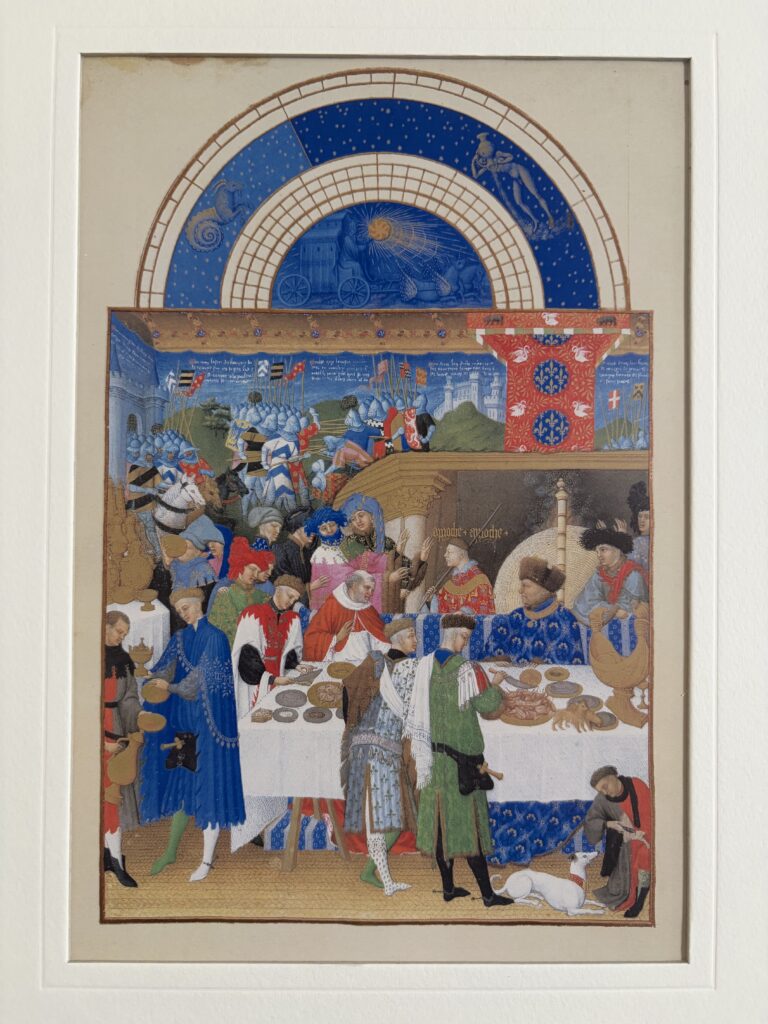
“Janvier, avec les signes du zodiaque Capricorne et Verseau” (January, with the zodiac signs Capricorn and Aquarius), Les Très Riches Heures du Duc de Berry (Paris, 1413), Chantilly, Musée Condé, Ms. 65. For more information, see. Leaf, CHS facsimile.
It is one of the most beautiful Books of Hours ever created. The artists were the Dutch miniature painters the Limbourg brothers and others. On 206 folios it features 66 large miniature illuminations and 65 small. The outermost circle contains the calendar dates, with the names of the zodiac signs ending and beginning in that month listed below. The two zodiac signs themselves are depicted in the blue band of stars beneath this section; in our image, there are Capricorn and Aquarius. The third field lists the name of the month and the number of days it contains, followed by the moon phases, the Golden Number (represented by letters), and, in the innermost section, the numerals for the days of the month in Arabic numerals. In the fourth panel, the sun god Phoebus rides the sun chariot drawn by winged horses, holding the sun’s disc in his hand. The illustration for January shows the large miniature from the Très Riches Heures du Duc de Berry calendar. The host sits at the table, wearing a blue cloak adorned with gold and a brown fur hat, welcoming his invited guests to the New Year’s reception. On the wall behind him, the inscription “approche, approche” can be read, “come closer, come closer!” These are evidently the words of the servant standing below. While the many guests, dressed in gold-trimmed robes and elaborate headgear, seem to step out of the painting behind them and into the hall to pay homage to the Duke, servants in the foreground are busy serving a lavish meal. Scenes from the Trojan War, reimagined in a contemporary French setting, are visible in the painting on the background wall. A tapestry bearing the coat of arms of the Duc de Berry (golden fleurs-de-lis on a blue field) hangs from the column standing in front of it. Beneath, the fireplace crackles, shielded by a woven screen. On the table, the Duke’s little lapdogs play amidst the fine gold tableware. There is also a golden salt cellar shaped like a ship (from Von den Gestirnen: Meisterwerke zur mittelalterichen Sternenwelt, Coron, 2022).
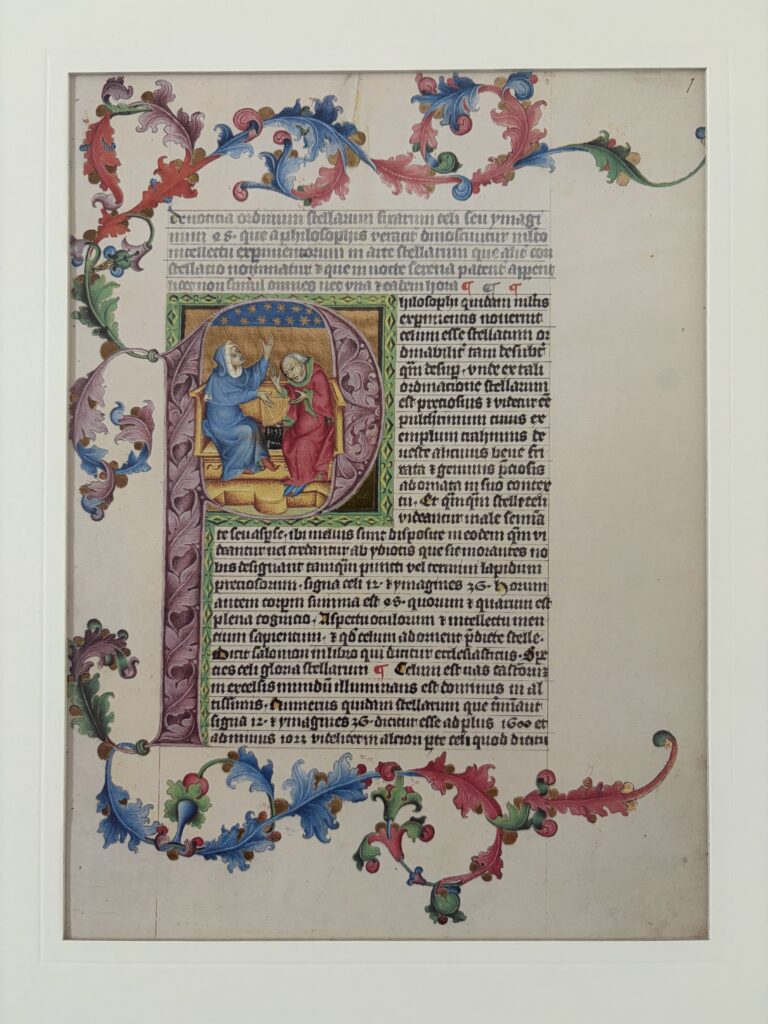
“Duo astronomi/astrologi,” Astronomische Sammelhandschrift König Wenzels IV (Prague, 1392-93) – Vienna, Österreichische Nationalbibliothek. Digital version. Leaf, CHS facsimile.
Text in Latin. The men hold a quadrant of the sun in their hands to calculate the hours of the day. They are depicted inside a historiated initial P, the beginning of the word “Philosophi” (from Von den Gestirnen: Meisterwerke zur mittelalterichen Sternenwelt, Coron, 2022).
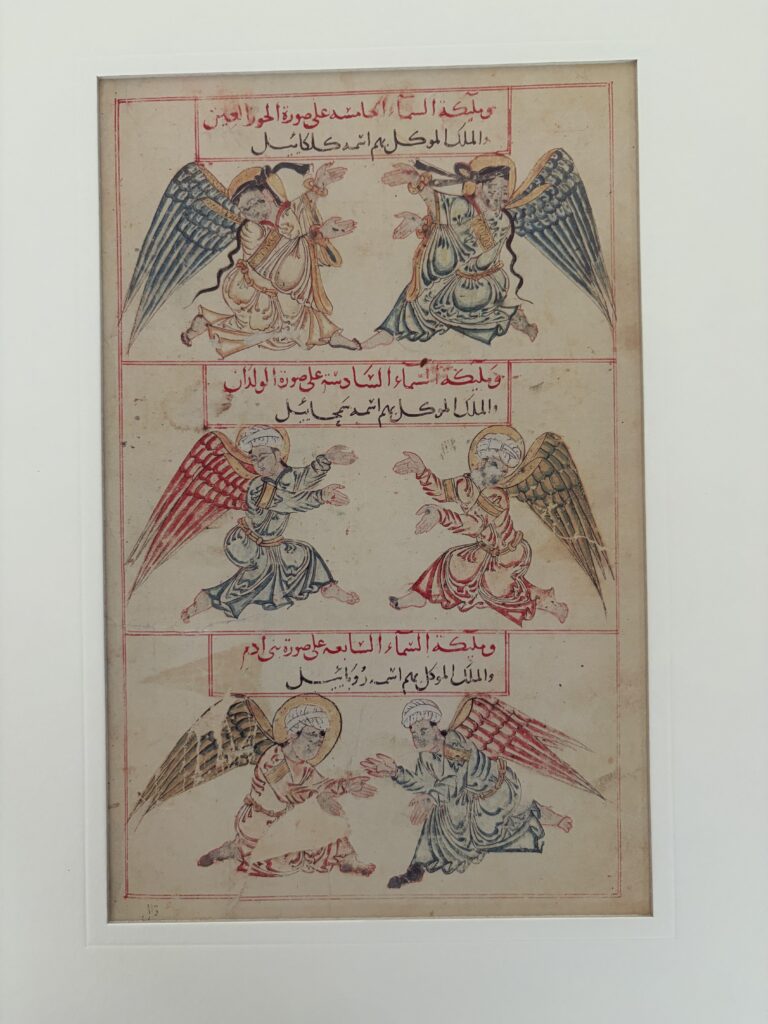
“Angel,” Al Kaswini (or Zakariya al-Qazwini’s) Kosmographie (Irak, 1280) – Munich, Bayerische Staatsbibliothek, Cod.Arab. 464, Bildnr. 34. Digital version. Leaf, CHS facsimile.
An Arabic encyclopedia of the universe. The first part of al-Qazwīnī’s text deals with things celestial including astrology and angels; the second part things terrestrial including a bestiary and a treatise on plants and minerals, and on humans (e.g., character, illnesses). Al-Qazwīnī discusses both the astronomical knowledge of his time and the influence of the planets on worldly events. He cites Ptolemy and others as sources. Towards the end of the 13th century, a cosmography was produced in Persia under the title The Wonders of Created Things and the Marvels of Existing Things; it has gone down in history as the most famous of all Islamic cosmographies. It was authored by Zakariya ibn Muhammad al-Qazwīnī who was born around 1203 CE in Qazvin, a city in Persia located approximately 150 km from Tehran. He came from an old Arabic family of legal scholars in Persia. Around 1233, he was in Damascus, Syria, where he became acquainted with the mystic Ibn al-Arabī (from Von den Gestirnen: Meisterwerke zur mittelalterichen Sternenwelt, Coron, 2022).
Dr. Aralere adds that, “this particular manuscript is so old that it is considered the original one actually written by al Qazwīnī himself, making it quite important for understanding the Arabic conception of the cosmos through visual images. The illumination above shows the angels inhabiting the fifth through seventh heavens and the translation of the text by Aida Alavi is presented below”:
| Position | English Translation | Arabic text |
| First part | And the angels of the fifth heaven are in the form of the houris (ḥūr al-ʿayn) And the angel appointed over them, his name is Kalkāʾīl | و ملٓیکة السماء الخامسه علی صورة الحورالعین و الملک الموکل بهم اسمه کلکایٔیل |
| Second part | And the angels of the sixth heaven are in the form of the youths (al-wildān) And the angel appointed over them, his name is Samḥāʾīl | و ملٓیکة السماء السادسه علی صورة الولدان و الملک الموکل بهم اسمه سمحایٔیل |
| Third part | And the angels of the seventh heaven are in the form of the children of Adam (human beings) And the angel appointed over them, his name is Rūbāʾīl | و ملٓیکة السماء السابعه علی صورة بنیادم و الملک الموکل بهم اسمه روبایٔیل |
Zakarīyā Ibn-Muḥammad al-Qazwīnī: ʿAǧāʾib al-maḫlūqāt wa-ġarāʾib al-mauǧūdāt.
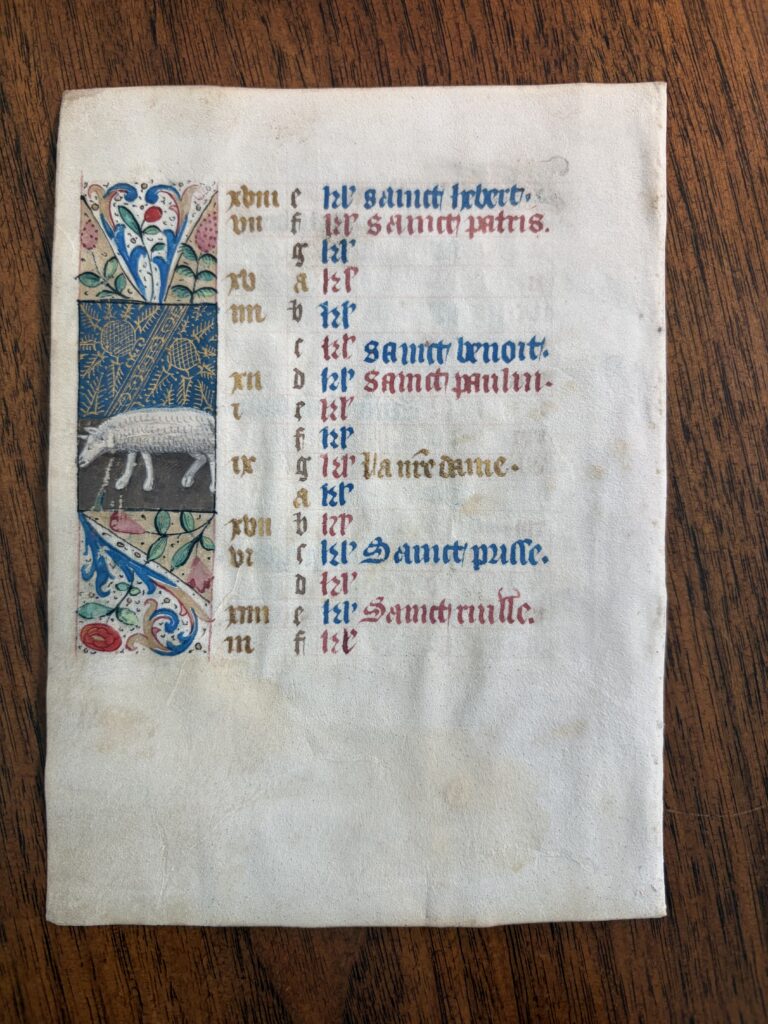
A single leaf from a Book of Hours manuscript. Northern France, probably Paris, ca. 1460. Original manuscript leaf, see CHS Digital.
16 lines of red ruled text in French, in blue, red or gold ink on vellum. Large “KL” (Kalendae) initials are in blue on a gold and floral background. The panel borders around the miniatures contain floral, ivy and acanthus leaves in gold, red, blue, green, and pink. The miniature shows the zodiacal sign (per the 1460 calendar) Aries to indicate the month of March. As was customary, the calendar contains the labors of the month on the recto and the signs of the zodiac on the verso. Saints’ Feast Days alternate red and blue with important days in burnished gold. Among the saints fêted are St. Gregory (12th, patron saint of musicians) and St. Patrick (17th, patron saint of Ireland). To the left of the list of saints’ days are repeated letters a-g referred to as Dominical Letters since they indicate Sundays. Far left is the column of Roman numerals i-xix called Golden Numbers to indicate appearances of the new moon, and counting ahead 14 days, full moons throughout the year + 1; divide by 19 (solar year); remainder is a Golden Number, if zero g-n, 19). Each month also had 3 fixed points: Kalends (1st day), Ides (middle, ca. 15th day), and Nones (9th day before Ides). All days in between were counted backwards from these days or points.
Further readings: There is a dearth of book-length treatises dealing with ancient astrology; however, here are a few.
Tamsyn Barton. Ancient Astrology. London; New York: Routledge, 1994.
Roger Beck. A Brief History of Ancient Astrology. Malden, MA; Oxford: Blackwell, 2007.
Markham J. Geller. Melothesia in Babylonia: Medicine, Magic, and Astrology in the Ancient Near East. Boston: De Gruyter, 2014.
P.G. Maxwell-Stuart. Astrology: From Ancient Babylon to the Present Day. Stroud: Amberley, 2010.
Peter Whitfield. Astrology: A History. Boston Spa: British Library, 2001.