
The works of the ancient Greek mathematicians Euclid and Archimedes have been immensely influential since antiquity. Two medieval/renaissance manuscripts and printed works which the library recently acquired in the form of facsimiles were especially important as they were the first Latin translations into a language understood by most European intellectuals of the time as opposed to Greek and Arabic. In addition, the translators not only had to tackle Greek, Arabic, and Latin but also mathematical and astronomical calculations and geometric symbols. The Archimedes manuscript with a Latin translation from Arabic by Jacopo da Cremona, for example, was unique in that it was transcribed and drawn by one of the most famous Florentine painters of the Renaissance (who was also a mathematician), Piero della Francesca. Of Piero’s works in mathematics three have survived. They discuss arithmetic, algebra, perspective (in painting), and geometry, especially, solid geometry. The latter was translated in Pacioli’s Divina proportione, a work illustrated by Leonardo da Vinci.
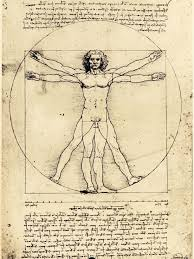
Ancient geometric principles were important to Renaissance artists, note Leonardo’s “Vitruvian Man” with a human male body inscribed within a circle and a square. The division of a line into two parts, such that the ratio of the larger to the smaller segment is equal to the ratio of the original line, as discussed in Euclid’s book 2, was referred to as the “golden section” by the artists and architects of the Renaissance.
The three men who authored the books or series of books discussed below were what we today might call polymaths. They were pagan Greeks living and working at least for a period in Alexandria in Egypt, the cosmopolitan city of Egyptians, Greeks, and Jews, populated with a large number of immigrants and merchants from the east and west, founded by Alexander the Great and ruled by a series of Ptolemies who built the ancient world’s largest and most important library of the papyrus scrolls in existence in the Greek world and a museum (mouseion). This museum did not house artifacts but was rather a research and educational center attracting the best and the brightest, including Euclid, Archimedes, and Ptolemy, all mathematicians, physicists, engineers, astronomers, astrologers, music theorists, and philosophers. In antiquity, science and the humanities were not viewed as distinct but connected expressions of human knowledge.
Euclid (fl. ca. 300 BCE), one of history’s greatest mathematicians, lived in cosmopolitan Alexandria and taught at the Mouseion and had the riches of the Library of Alexandria at his disposal. He may also have studied at Plato’s Academy in Athens. This is the extent of his “known” biography. Euclid is sometimes referred to as the “Father of Geometry” although geometry was not invented by him and had been used by the Egyptians in their pyramids and the Babylonians and the Indians and the Chinese and by earlier generations of Greeks as well, including Pythagoras and Plato, and others. Euclid’s unique contribution consists in systematizing the field and introducing a logical structure and reasoning and clear rules and a step-by-step approach to geometry. Euclid’s most frequently cited work is Elementa Geometriae, used as the textbook on geometry from ca. 300 BCE to ca. 1900 CE, so for more than 2,000 years, describing lines, triangles, angles, polygons, parallelograms with a series of axioms and notions such as “All right angles are equal” and “The whole is greater than a part” and theories of ratio and proportion, and number theory.
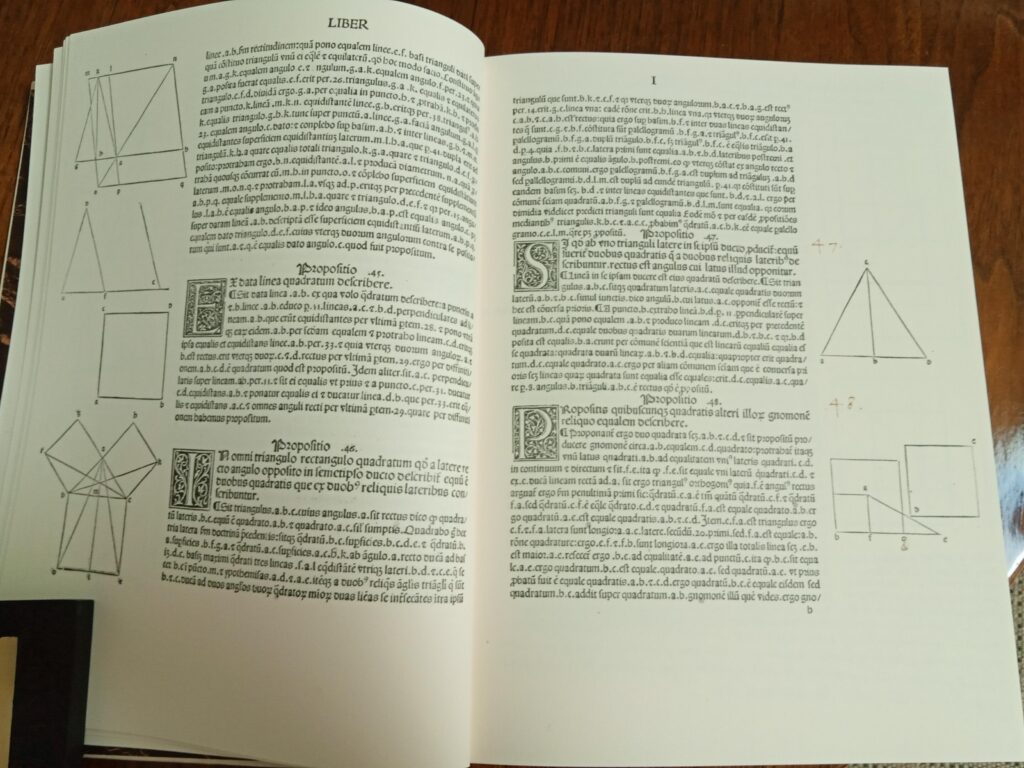
The Elementa (Στοιχεῖα) consists of 13 books or scrolls. Book 1 contains basic geometry, definitions, postulates, common notions, parallel lines, triangles, including the Pythagorean theorem (1.47); Books 2-4 circles, polygons, geometric “algebra”; Book 5 propositions, rations, irrational numbers; Book 6 applied proportions to plane figures, triangles and parallelograms; Books 7-9 arithmetic, number theory, prime numbers (including proofs that there are an infinite number of primes), common divisions, including locating the greatest common divisor of two or more numbers, usually referred to as the “Euclidean algorithm”; Book 10 irrational lines; Books 11-13 three-dimensional solids, cubes.
The Greeks learned mathematics, including geometry, from the Babylonians and the Egyptians, the Arabs learned it from the Greeks, and medieval Europe learned it from Islamic scholars. Before the Renaissance only a few fragments existed of the original Greek texts in the west which were translated into Arabic, and later into Latin. Prior to 1533 when the editio princeps was printed in Greek by Simon Grynaeus in Basel, the Elementa was only available in Latin translations. The first direct translation from the Greek without an Arabic intermediary was made by Bartolomeo Zamberti and published in Vienna in Latin in 1505.
We know of at least some commentaries written already in late antiquity, including that of Theon of Alexandria (ca. 335–405 CE), mathematician Hypatia’s father. His edition was the Greek source for all subsequent Arabic and Latin translations until the 19th century when an earlier Greek edition was discovered in the Vatican without Theon’s scholia, such as alterations and additions. François Peyrard’s edition (see the Text Editions section below), based on the Vatican manuscript of the Greek text, was the first to use the newly discovered Vatican MS to correct errors with notes in Greek, Latin, and French.
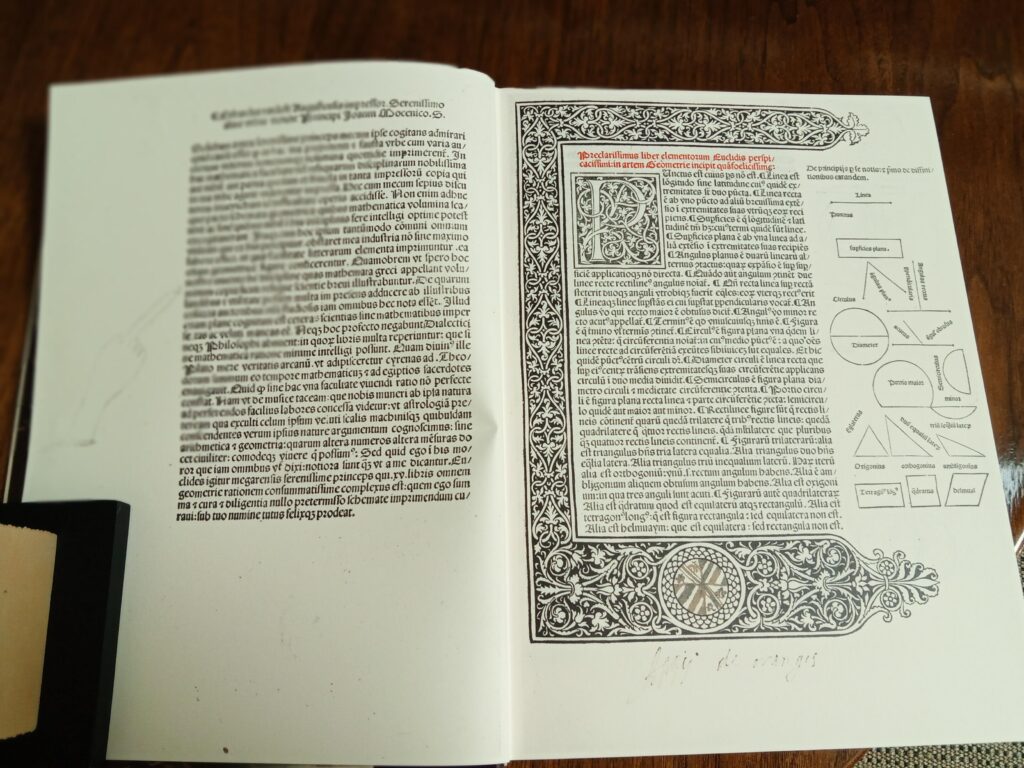
The work from which the CHS facsimile was produced was published in Venice in 1482. This was the first printed version of Euclid’s work. It was copied from Adelard of Bath’s 12th-century translation of an Arabic version of the original Greek and is the earliest extant Latin translation (Elementa — Preclarissimus liber elementorum Euclidis Perspicacissimi: in artem Geometrie incipit quafoelicissime). Adelard is among other things credited with introducing Arabic numerals to western Europe. While not in Greek, the 1482 Adelard Venice edition, printed by Erhard Ratdolt, was widely used. It demonstrates not only Euclid’s groundbreaking ideas but also the new printing technique of the time. By using flexible type-metal rules, the printer Ratdolt integrated figures directly with the letterpress text and woodcuts. In his preface, he addressed the rarity of mathematical texts, attributing it to the challenge of reproducing geometrical diagrams. An incunabulum of this 1482 edition is housed in the Schlesinger Library at Harvard.
Discussing this and other editions of Euclid’s work, CHS Director and Harvard Professor Mark Schiefsky notes that “the diagrams in Euclid editions are especially interesting. They raise questions about how they were drawn (from the text itself, based on manuscript diagrams, etc.). Also, they sometimes specify features of the geometrical configurations that are not determined by the text and sometimes they over-specify the geometrical situation (e.g., drawing an equilateral triangle when any old triangle would do) and sometimes deviate from what is “metrically correct” (e.g., line AB is said to be twice BD, but it is not drawn as such). Sometimes the scribes/editors seem to be copying the diagrams from their source; sometimes they seem to be drawing them afresh.”
This is a peculiarity no doubt due to the many different scribes and editors and translators over two millennia who may have used edited or commented sources since lost or who may indeed have added their own interpretations to clarify or educate or “improve” upon Euclid’s models.
Engineers, architects, painters, philosophers, astronomers, physicists, and lawyers used Euclidean methods, even an American president like Abraham Lincoln who studied Euclid to refine arguments through deductions from axioms. The title of this blog post was inspired by a poem by Edna St. Vincent Millay, “Euclid alone has looked on Beauty bare.”
Archimedes of Syracuse (ca. 287–ca. 212 BCE), usually considered history’s greatest mathematician, at least until Newton, was also a physicist, engineer, music theorist, and astronomer. He proved several geometrical theorems such as the volume of a sphere, the area of an ellipse and a circle and a spiral. He measured the universe and the diameter of the Sun, and he proved the law of buoyancy known as Archimedes’ Principle. He further built a planetarium and defensive war machines. Several of his works have survived, the Equilibrium of Planes, Quadrature of the Parabola, On the Sphere and Cylinder, On Spirals, On Conoids and Spheroids, On Floating Bodies, Ostomachion, The Cattle Problem, The Method of Mechanical Theorems. Archimedes transmitted his works in his correspondence with the principal mathematicians of his time, including Eratosthenes of Cyrene and Conon of Samos, both living and working in Alexandria.
Archimedes is perhaps best known for his discovery of the relationship between the surface and volume of a sphere and its circumscribing cylinder, the volume of a sphere is two-thirds that of the cylinder in which it is inscribed, for which he himself was clearly proud. So much so that he had requested that a circle within a cylinder decorate his grave, a fact which led Cicero to discover his overgrown grave almost 200 years later. Archimedes was also an astronomer measuring the distances of the various heavenly bodies, including the distance of the Sun from the Earth, based on Pythagorean theory associating the spatial intervals between the planets with musical intervals rather than astronomical observations, and even measuring the size of the Universe and coining the expression “the center of gravity.”
Just like Euclid, Archimedes spent time in Alexandria although his hometown was Syracuse where he worked on circles and levers and calculated diameters, circumferences, pinpointing the exact value of π, and anticipating integral calculus by using the concept of infinitesimals to prove geometrical theorems such as the areas of circles and volumes of spheres, and the areas of ellipses and spirals; in the bathtub, he wondered why ships float and, as mentioned earlier, discovered the law of buoyancy. He also discovered that the level of the water in the tub rose more the lower he sank in the tub proving a case of forgery of a golden crown filled with silver (the “eureka” moment, which may be a good story, rather than one based in fact).
Archimedes was appointed chief engineer and “royal” mathematician at the court of Hieron II where, among other things, he built war machines in an effort to save Syracuse from the Romans. Thanks to Archimedes’ efforts, the Syracusans held the Romans at bay for two years, but the siege ended with the defeat of Syracuse in 212 BCE and Archimedes’ own death at the hands of a Roman soldier.
The use of geometry in the theory of linear perspective was developed by the early Florentine Renaissance architects Filippo Brunelleschi (1377–1446) and Leon Battista Alberti (1404–72). A feature of this system was the “point at infinity” at which parallel lines in the painting appear to converge. The use of geometry and linear perspective was further developed by Piero della Francesca (ca. 1410–92).
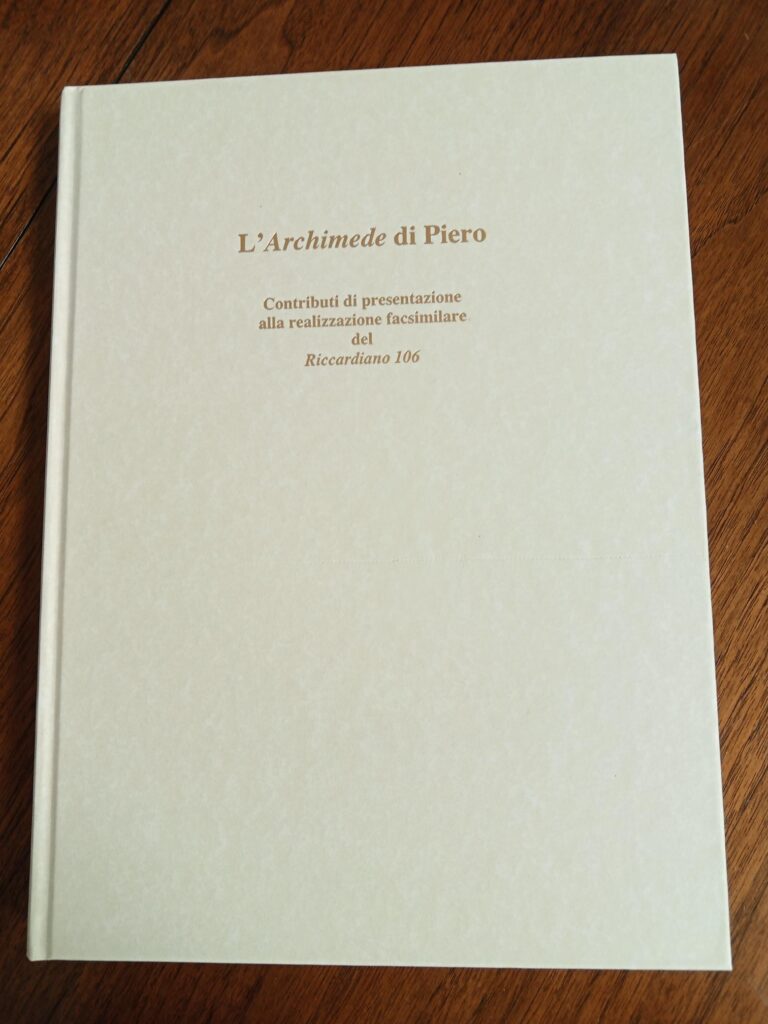
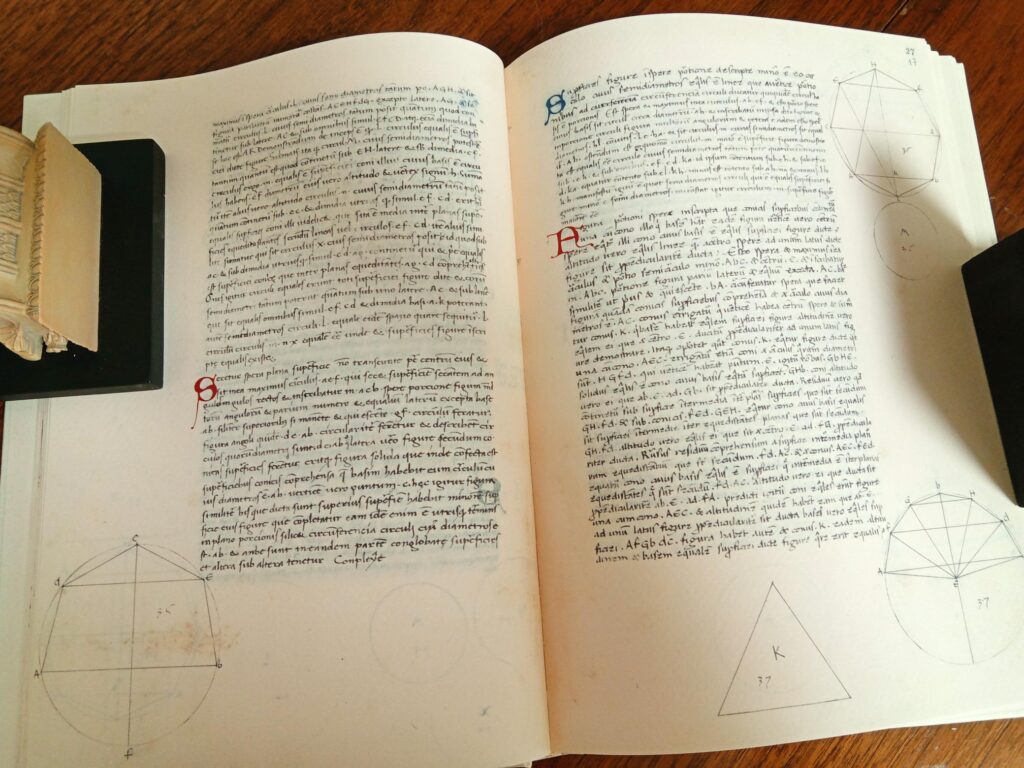
Archimedes’ work was translated into Arabic in the 9th century and then into Latin in the 12th century. The surviving Greek texts are from three Byzantine codices including the so called Archimedes Palimpsest (10th century) overwritten by a prayer book from the 13th century. The CHS manuscript facsimile is a Latin translation from Greek by Jacopo da Cremona (aka Iacopo da San Cassiano or Iacobus Cremonensis) produced under the patronage of Pope Nicholas V around the mid-15th century. The manuscript is in Biblioteca Riccardiana in Florence (MS Ricc. 106) and is unique in that it features Piero della Francesca’s copying of the works of Archimedes. Not only was Piero della Francesca one of the greatest painters of the Renaissance but he also transmitted mathematical knowledge in this way. It is thought that the artist completed the transcription at Sansepolcro after 1468.
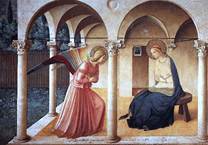
Piero’s hand is recognized through distinctive letter forms and a consistent ductus (pen or brush stroke), while the manuscript also preserves the trace of a second copyist responsible for portions of the text. The book contains red and blue rubrics, filigreed initials, and pen ornaments. Margins sometimes widen to accommodate the geometric figures, which function not as embellishment but as the manuscript’s operative language. The manuscript includes much of the Archimedean extant corpus — De sphaera et cylindro (Books I–II), Circuli dimensio, De conoidibus et sphaeroidibus, the Spiralia, treatises on centers of gravity and equilibrium, Quadratura parabolae, and De arena numero.
The physical exhibit in the library has the display space sharing three ancient Greek mathematicians, Euclid, Archimedes, and Ptolemy, the latter whose manuscript facsimile was acquired last year by the library.
Ptolemy (ca. 100–160s/170s CE) was also a famous Greek mathematician living and working in Alexandria. He wrote about a dozen books important for Byzantine, Islamic, and western European science. Three of these include an astronomical treatise known as the Almagest (originally known as Μαθηματικὴ Σύνταξις, “Mathematical Treatise”) using mathematical methods to predict the motions of the sun, moon and other planets, the Geography about map-making based on geometric calculations and astronomical observations of ca. 8,000 place names in Europe, Africa, and Asia, and an astrological treatise commonly referred to as the Tetrabiblos.
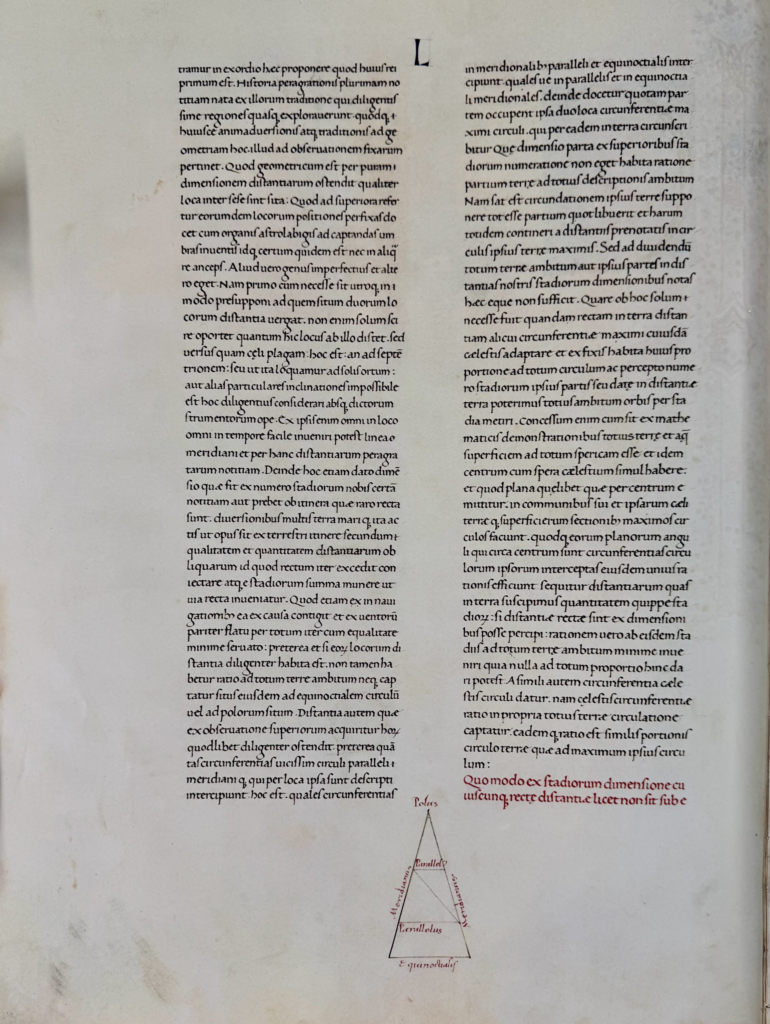
The word geometry means “measuring the Earth,” i.e., it studies spatial relationships among objects and the properties of surrounding spaces, and was used to solve practical problems such as surveying, and, in the case of Ptolemy, map-making although he did not just map the areas of the Earth. Ptolemy, the mathematician, music theorist, astronomer, astrologer, and cosmologist, also geometricized the cosmos, the heavens, asserting that the Sun and the Moon, and all planets move around a stationary Earth in rotating spheres, circles, and epicycles (i.e., a small circle (the epicycle) rotates around a point that itself moves along a larger circle used to explain the backward motion of planets while claiming a geocentric view of the universe). In fact, he constructed complete sets of circles for all the planets. In an effort to calculate the radius of the Earth, Ptolemy computed the solar distance in terms of the lunar distance and equated the maximum distance of the Moon with Mercury riding on its epicycle; the farthest distance of Mercury with the closest distance of Venus; and the farthest distance of Venus with the closest distance of the Sun. Ptolemy also calculated a table of chords which correspond to the trigonometric sine function later developed by Indian and Islamic mathematicians. Geometry not only made it possible to speculate about the structure of the universe but also gave it the means to measure it.
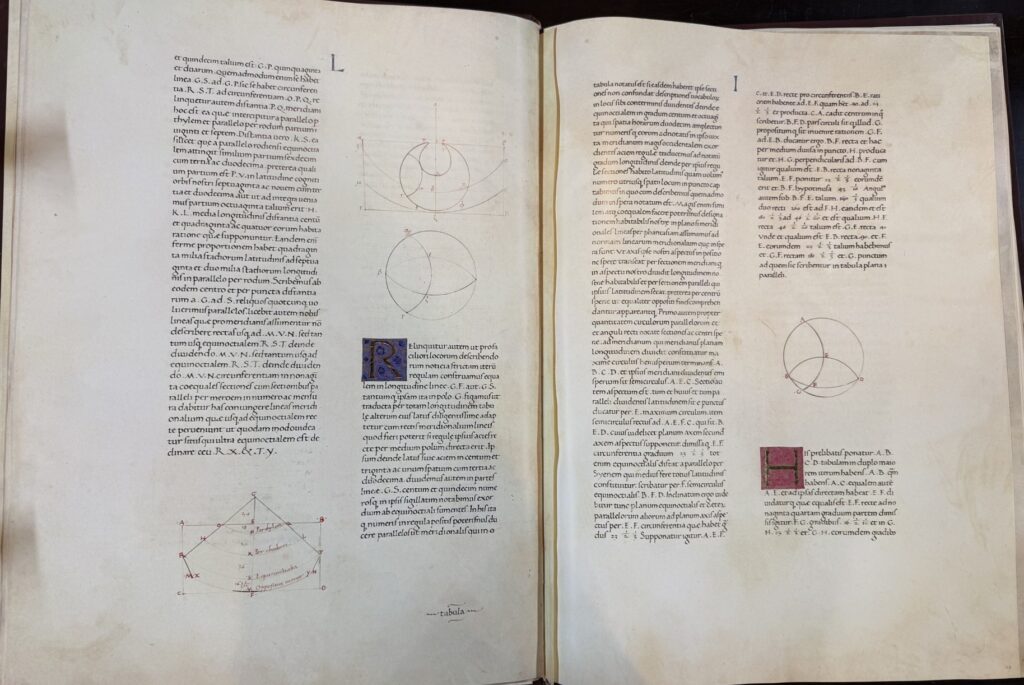
Ptolemy’s geocentric understanding of the cosmos prevailed until the discoveries of Copernicus (1473–1543) and Galileo (1564–1642) some 1,500 years later although another ancient Greek mathematician and astronomer working in Alexandria, Aristarchus of Samos, followed by Seleucus of Seleucia, had already presented a heliocentric view of the universe related in Archimedes’ The Sand Reckoner (Psammites, De arena numero) (containing Archimedes’ hypothesis of a number greater than the grains of sand to fill the universe), but the geocentric authorities of Aristotle and Ptolemy prevailed until the late Renaissance.
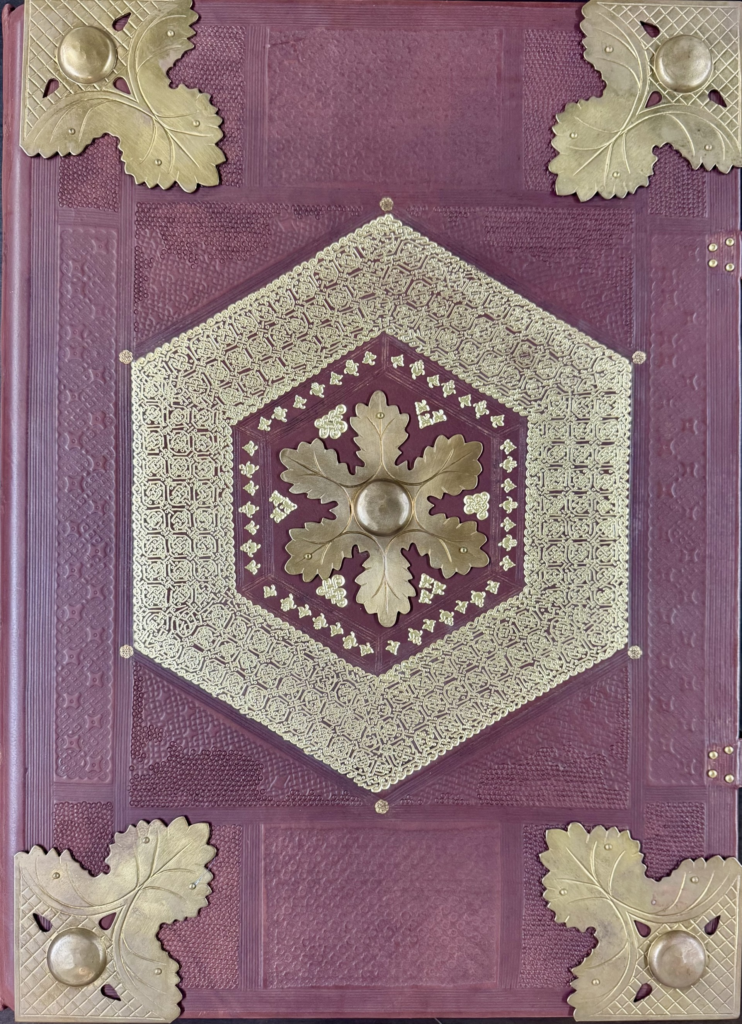
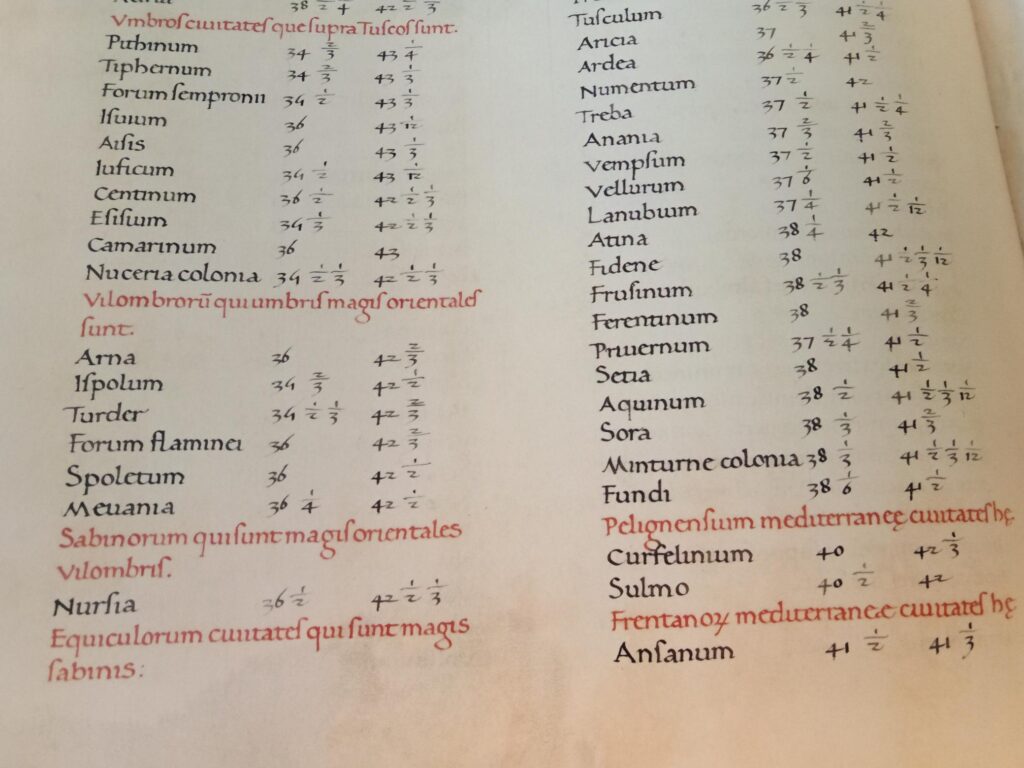
The CHS manuscript facsimile features the first Latin translation from Greek of Ptolemy’s Geography from 1409. The translator was Jacobus Angelus (Jacopo di Angelo) of Scarperia. Although his translation was criticized, it made Ptolemy a “bestseller.” The original manuscript (Urb. Lat. 277) is in the Vatican Library and was commissioned by Federico da Montefeltro, Duke of Urbino, whose famous portrait in the Uffizi was painted by Piero della Francesca.
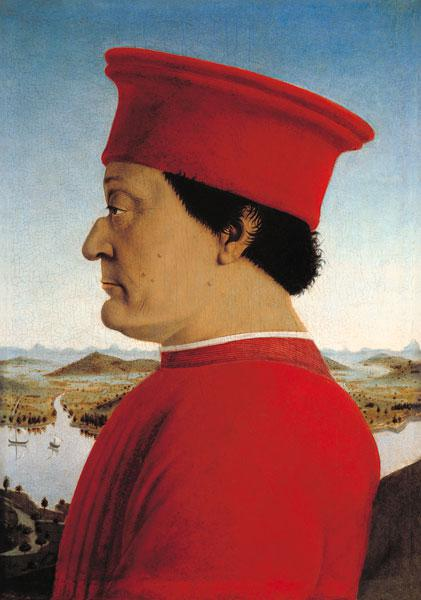
From the mid-15th century cartographers tried various projections of the sphere when recording the many geographical discoveries of the era. For them the Latin translation of Ptolemy’s Geography was a game-changer.
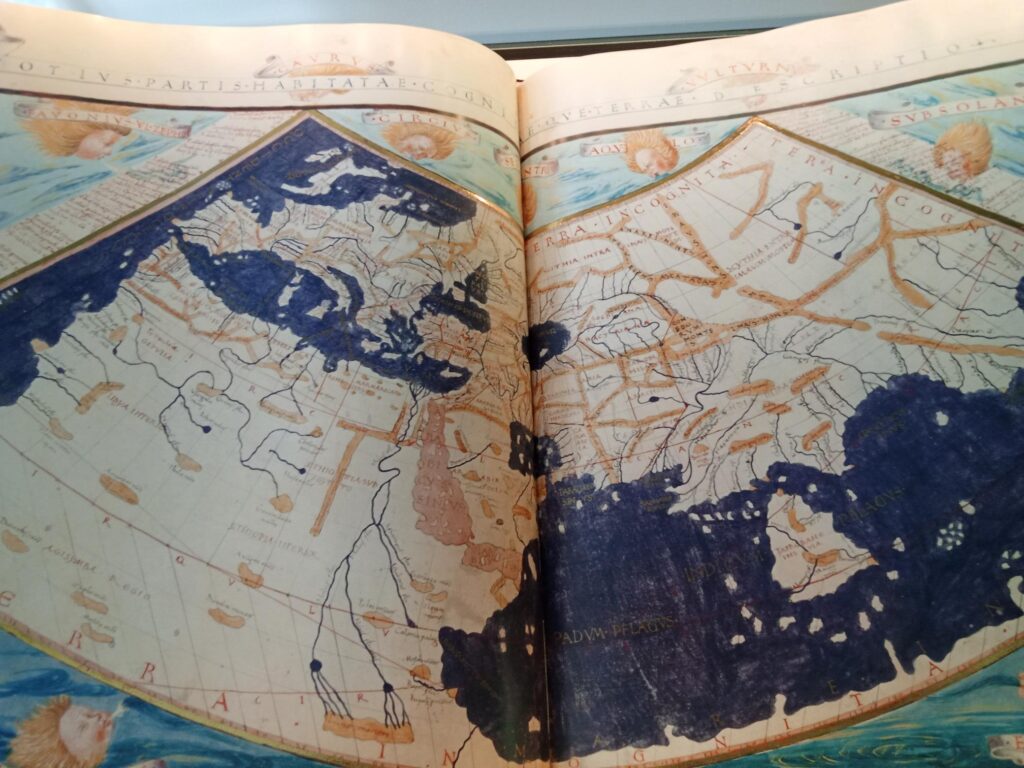
Ptolemy documented locations by calculating their latitudes and longitudes placed as coordinates in a grid and projecting them onto a sphere or globe and eventually onto a two-dimensional map of the world used to chart the new age of exploration.
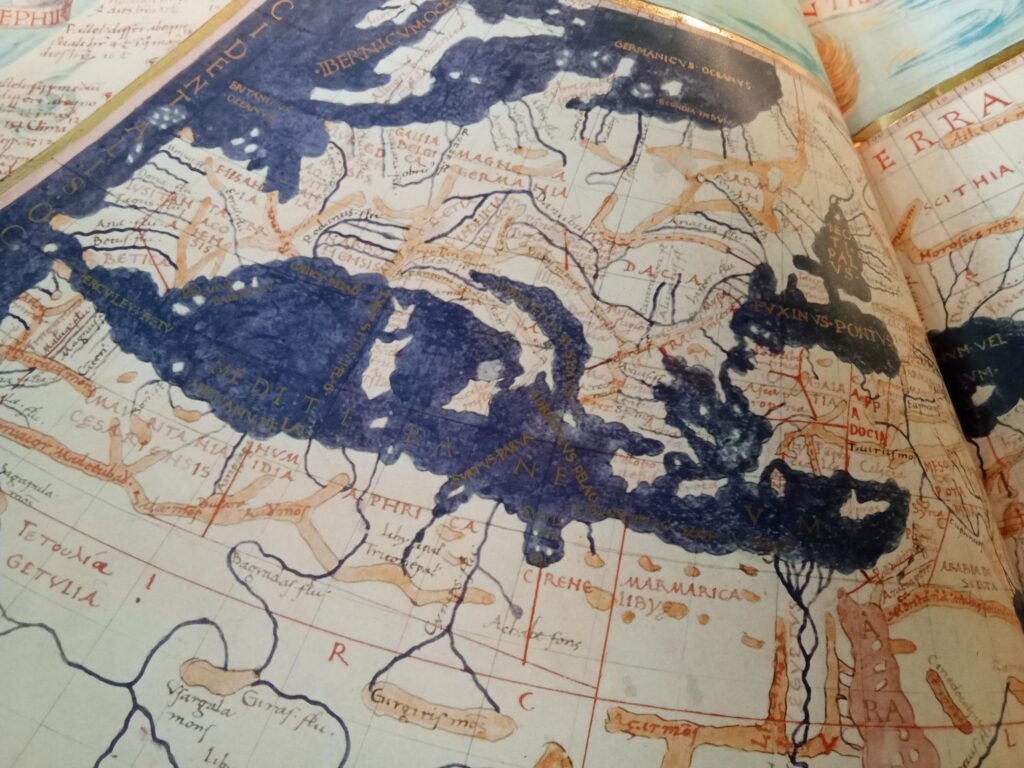
Ptolemy’s latitude (north-south) coordinates (360 degrees to a circle and 60 minutes to a degree) were measured from the Equator and his longitude (east-west) coordinates from a point somewhere west of the westernmost point, often identified as the mythological “Blessed Islands.” Several Blessed Island candidates have been proposed such as the Azores, the Canary Islands, Madeira and others. There are errors (the connection of Africa with China making the Indian Ocean into a large lake, the supersized Sri Lanka (Taprobane) versus India, the equally exaggerated size of the Mediterranean east-west, etc.) but also much that is correct.
Some Text Editions:
Note that several of the manuscripts mentioned above are included in CHS Digital.
Euclid
Les élémens de géométrie d’Euclide, traduits littéralement, et suivis d’un traité du cercle, du cylindre, du cône et de le sphère, de la mesure des surfaces et des solides, avec des notes (1809). 2. éd., augm. du cinquième livre, par F. Peyrard … Ouvrage apprové par l’Institut, et adopté par le gouvernement pour les bibliothèques des lycées … Paris: F. Louis.
Euclid (1990–2001). Les Éléments, 4 vols. Gen. intro. M. Caveing. Trans. and commentary B. Vitrac. Paris.
Euclid (2007). Tutte le Opere, ed. F. Acerbi. Milan.
Euclid’s Elements in Greek: from Euclidis elementa (2005). The Greek text of J.L. Heiberg (1883) with an accompanying English translation by Richard Fitzpatrick. Austin, Tex.: Richard Fitzpatrick.
Heath, Sir Thomas L. (1956). The thirteen books of Euclid’s elements. Translated from the text of Heiberg, with introduction and commentary by Sir Thomas L. Heath. 2d ed., rev. with additions. New York: Dover Publications.
Heiberg, I. L. and Menge, H., eds. (1883–1916). Euclidis. Opera omnia, 8 vols. Leipzig.
Archimedes
Archimède (1970-1972). Texte établi et traduit par Charles Mugler. Paris: Les Belles Lettres.
Greek mathematical works (2014). With an English translation by Ivor Thomas. Cambridge, MA: Harvard University Press. Vol. 1: Thales to Euclid; vol. II: Aristarchus to Pappus (also Archimedes and Ptolemy’s table of sines).
Opera omnia, cum commentariis Eutocii (1972). Iterum edidit Johan Ludvig Heiberg, corrigenda adiecit Euangelos S. Stamatis. Editio stereotypa editionis 1910-[15]. Stutgardiae: In aedibus B. G. Teubneri.
Ptolemy
Berggren, J. L. and Jones, A., trans. (2000). Ptolemy’s geography: an annotated translation of the theoretical chapters. Princeton: PUP.
For reproductions of the maps see:
Fischer, J. Claudii Ptolemaei Geographiae codex Urbinas Graecus 82 (1932). Phototypice depictus consilio et opera curatorum Bibliothecae Vaticanae. Lugduni Batavorum: Apud E. J. Brill; Lipsiae: Apud Ottonem Harrassowitz.
and
Klaudios Ptolemaios Handbuch der Geographie: griechisch-deutsch (2006-2009). Alfred Stückelberger und Gerd Grasshoff unter Mitarbeit von Florian Mittenhuber … [et al.]. Basel: Schwabe Verlag.